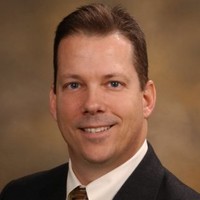
FIVE QUESTIONS WITH FILMMAKERS TIM HASHKO AND DON SAWYER

BY BRAD DURHAM

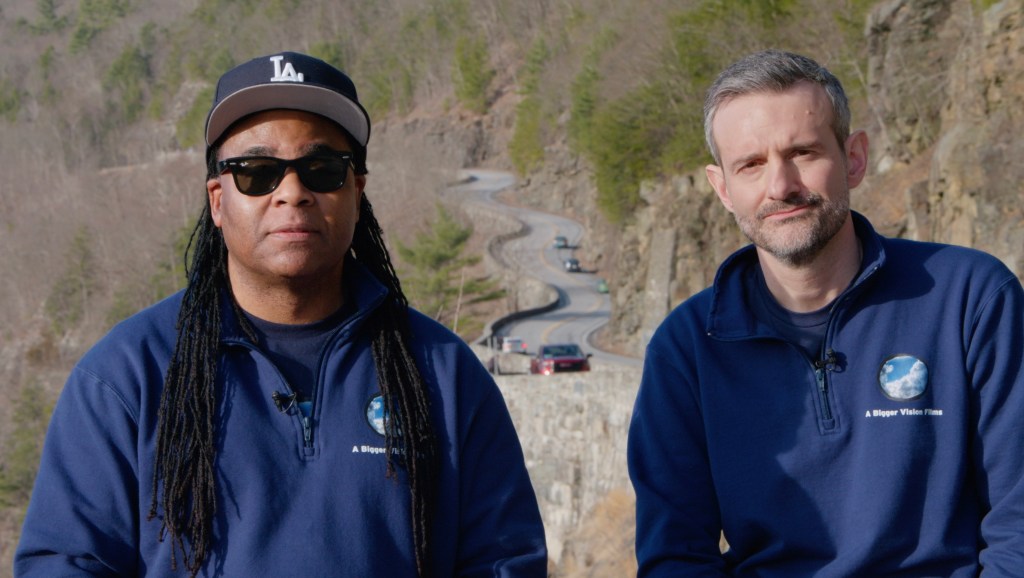
Left to right: Don Sawyer and Tim Hashko

MATCH (McMinnville Action To Create Housing) is bringing the film, Beyond The Bridge to the Park Theater on January 22, 2026. A Town Hall Meeting will take place immediately after the film. The filmmakers, Tim Hashko and Don Sawyer will be in McMinnville the day of the film and at the screening for various meetings. This interview serves as an introduction to them and their experiences in making the film.

BD Newsletter: Why did you make the documentary film, Beyond The Bridge?

Tim Hashko and Don Sawyer: Most documentaries about homelessness focus on how sad, lonely, and what a pathetic state people experiencing homelessness are in. This is true. But what needs to happen to fix the situation? We thought that if America can successfully keep a space station orbiting the earth for many years now, America can also successfully solve homelessness. We just didn’t believe solving homelessness is beyond the capability of this country, so we set out on a journey to discover the solution for ourselves. 

BD Newsletter: What is the most common reason towns have not developed a strategic plan to solve homelessness? What is the common denominator in these towns?

Tim Hashko and Don Sawyer: There are two very common reasons communities struggle when it comes to creating an effective strategic plan to address homelessness. First, in most communities, there is a deep, unspoken belief that homelessness is an intractable problem that can never be solved. If you don’t believe you can solve the problem, then you will never solve the problem – a fundamental principle when pursuing any goal. Second, most communities (sometimes inadvertently) set their homeless response systems up to serve their local government, service providers and the housed public. In other words, the welfare of these groups are prioritized over the welfare of the people experiencing homelessness. For many communities the priority of their homeless response system is to get the homeless population out of sight and out of mind instead of meeting them at their need and leading them out of homelessness – when this is the objective of a homeless response system, it will always end in failure.

Have you seen a difference in the approach and resources committed to solving homelessness in small and large cities? In other words, have you seen small towns practice the same plans large towns use?

Tim Hashko and Don Sawyer: The scale is different, but the fundamentals are the same. Large cities tend to have more resources and more complex systems, while small towns often assume those models do not apply to them. What we found is that the core strategies that work in big cities also work in small communities when they are adapted to local conditions. In fact, small towns often have an advantage because relationships are closer and change can happen faster.
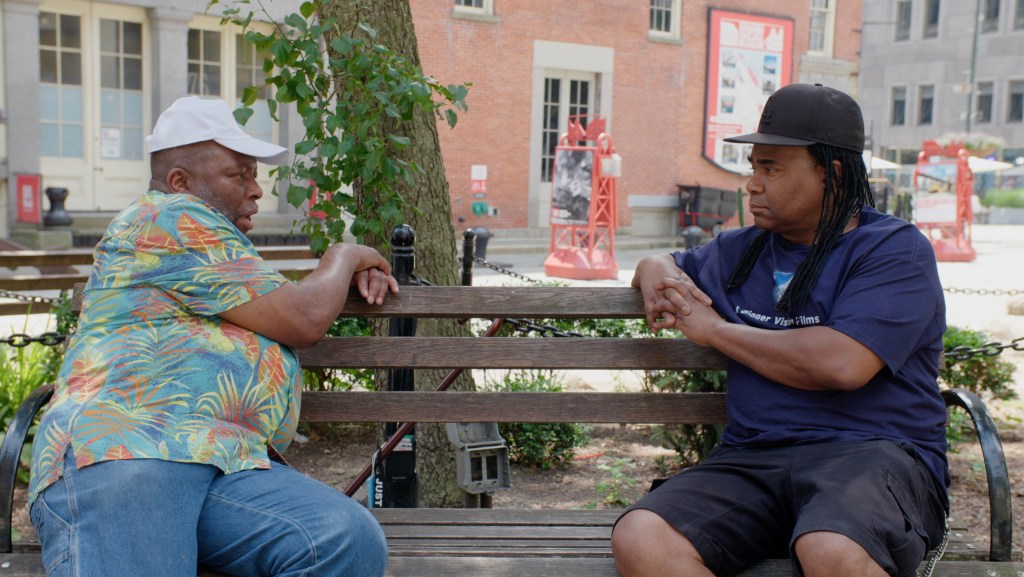
Don Sawyer interviewing Rob Robinson, a prominent
community organizer, activist and formerly homeless.

BD Newsletter: What is the number one reason you want people to see your film?

Tim Hashko and Don Sawyer: To change perspectives on people experiencing homelessness, and to learn why homelessness exists in this country. Then, we want people to see that homelessness is solvable by deploying the blueprint we show in the film, which applies to every community no matter how big or small a community is. Ultimately, we’d like people to understand that if they want different results in their efforts to address homelessness, they will have to band together as a community to make it happen – everyone has a role.

BD Newsletter: Why should a private citizen, service provider, business person, and elected officials see this film? On the other hand, is there anyone in McMinnville who should not see Beyond The Bridge?

Tim Hashko and Don Sawyer: Homelessness affects the entire community, and solutions require participation from everyone. The film gives private citizens a clearer understanding of what actually works, service providers a framework for stronger collaboration with other organizations, business leaders insight into how they can help, and elected officials examples of effective leadership grounded in results rather than theory.

There is no one who should not see this film. It is not political and it does not promote a single ideology. It presents evidence, lived experience, and real world solutions, and invites the whole community into a more productive conversation.


https://www.eventbrite.com/e/beyond-the-bridge-a-solution-to-homelessness-film-conversation-tickets-1977519276389?utm-campaign=social&utm-content=attendeeshare&utm-medium=discovery&utm-term=listing&utm-source=cp&aff=ebdsshcopyurl

LINDSEY KRINKS VISITS MCMINNVILLE

LINDSEY KRINKS

BY BRAD DURHAM

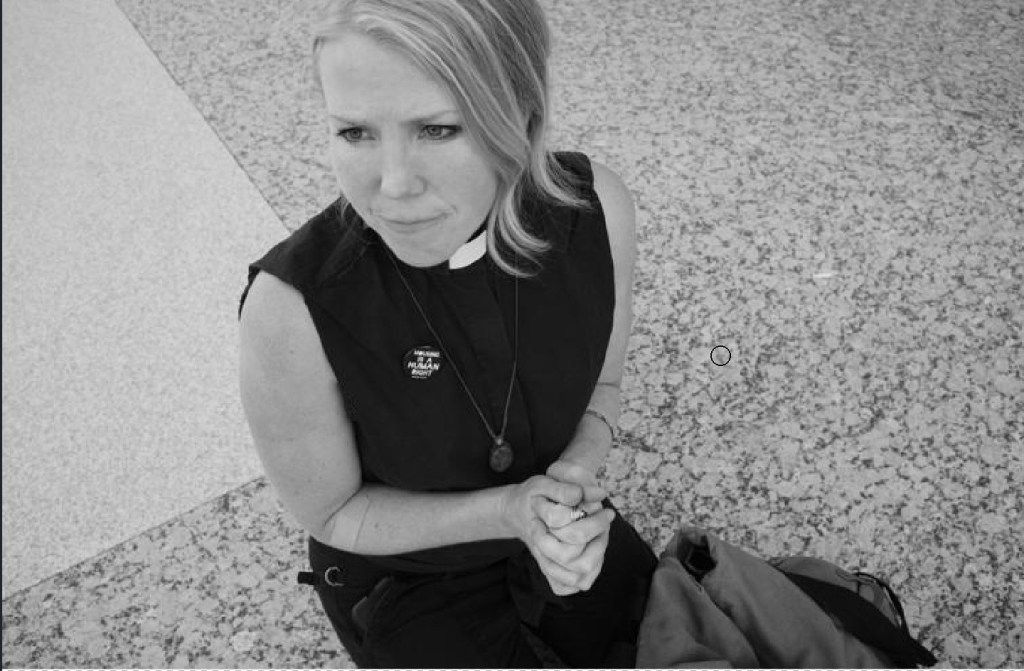
Recently, Lindsey Krinks visited McMinnville and spoke to a group of people working with unhoused individuals in the community. Not only did Krinks travel 70 miles to reach McMinnville, but she has traveled a great distance in her lifetime—going from South Carolina to David Lipscomb University, then to Vanderbilt Divinity School. She has made her way from Tent City to Otter Creek to Legislative Plaza. Throughout her journey, she has undergone transformative experiences rooted in a spiritual quest.

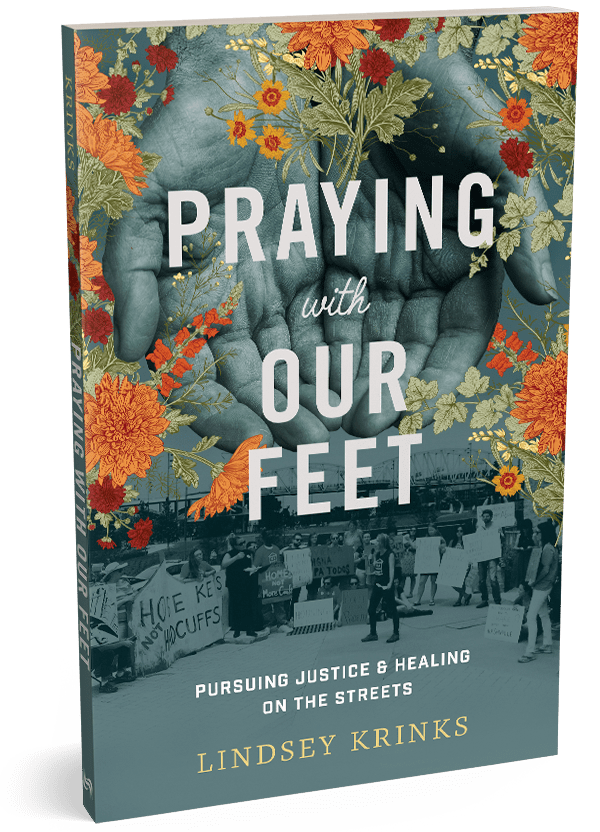
After inviting Lindsey Krinks to meet with us, I read her book, Praying with Our Feet. As I read her autobiography, I couldn’t help but think of Joseph Campbell’s Hero’s Journey. The hero embarks on an adventure beyond the ordinary and returns with a message. Lindsey’s story mirrors this: she has faced moments of almost breaking down physically, mentally, and spiritually—yet she persevered and was transformed. Her drive to serve the poorest of the poor—the homeless—has fueled her journey.

For me, reading Lindsey’s book felt like uncovering stories of saints such as Saint Francis of Assisi and Mother Teresa—people who led lives of profound transformation and became signposts along the journey of imitating Christ.

Lindsey Krinks is the real deal—she is a street chaplain, author, activist, and nonprofit leader. She is the co-founder of Open Table Nashville. I’m grateful she visited us to share her story and an excerpt from her book, Praying with Our Feet.

After the meeting, I asked Lindsey a few questions. The following is part of that interview during lunch at The Local in McMinnville.

BD NEWSLETTER: What motivated you to work with the homeless?

LINDSEY KRINKS: Growing up, members of my family—their experiences with homelessness—shaped my perspective. My cousin and uncle experienced homelessness, and I initially thought it was a personal decision on their part. But when I got to college in Nashville, I realized that poverty is much more widespread than individual choices. I started re-reading the Hebrew prophets and the Gospels, and a conviction grew in me: if we are truly followers of Christ, we must go where Jesus went. We are called to the margins—to love, to extend our hand, share food, and provide shelter. And if we take Matthew 25 seriously, we are also called to find Christ there.

Understanding how widespread and systemic the problem is—beyond personal failures—has deepened my call to be the hands and feet of Christ. Compassion at this larger level is justice. That’s a significant part of what pulled me into this work. But once I built relationships with people on the street, I was amazed by who they are and what they had survived. After forming those relationships, there was no way I could go back to anything else. It has been the most raw, real, and transformative experience I’ve ever been part of.

BD NEWSLETTER: What influenced you to attend Vanderbilt Divinity School after graduating from David Lipscomb University?

LINDSEY KRINKS: I started becoming involved with issues of homelessness and affordable housing during my time at Lipscomb. Influences included dedicated teachers, books I was reading, and a service club that truly changed me.

I was introduced to authors like Shane Claiborne (The Irresistible Revolution), Dorothy Day (The Long Loneliness), and saints such as St. Francis and Mother Teresa. Those are the things that started working on me as I graduated from Lipscomb as a young adult and thinking about what I wanted to do in the world.

I met Charlie Strobel, founder of the Room at the Inn and homeless services in Nashville—someone I considered a literal saint living among us.

I took a few years off after college to work on the streets. I spent two years with AmeriCorps in a homeless outreach program within a mental health agency. The questions of faith, suffering, and liberation kept haunting me. I wanted to explore these issues theologically, which led me to Vanderbilt Divinity School. I knew the school had the tools I needed, and I also had gained tools at Lipscomb. Vanderbilt welcomed me warmly. As a young Church of Christ member, I had a phenomenal experience—meeting others wrestling with Scripture, reflecting deeply, and sharpening my faith and commitments.

BD NEWSLETTER: In your book, you mention a Vanderbilt professor who asked what you were running from. Could you describe the context of that question and how you found the answer years later?

LINDSEY KRINKS: During my first or second year at Vanderbilt, I was part of a small group discussing pastoral care. I was exhausted, burning the candle at both ends—working at shelters, trying to help everyone around me. It’s common for “fixers” to go full throttle…but if done excessively, it’s unhealthy.

My professor noticed I was doing good work but not in a sustainable way. After I expressed my exhaustion, she asked, “What are you running from?” I was defensive and replied, “I am not running from anything.”

It took digging into therapy to realize and say, “Oh, I keep falling into this over-functioning fixer role because of the family system dynamic that was ingrained in me. I was also struggling with survivor’s guilt. I work on the margins and was seeing people on the streets dying from preventable causes. Globally, I was seeing poverty on an enormous scale. Looking at my own family system, I’ve lost cousins and uncles—one of my uncles died on the street and another uncle died after getting out of prison. I’ve watched family systems implode. I had been navigating survivor’s guilt. I believed that if I’ve survived these toxic systems, then I had to try to pull everyone out of these systems.

We see this with war veterans and people who survive childhood trauma. Once I got to the root of that and started to name it, I could begin to respond from a place of love rather than guilt. Love is a deeper well—one that says I am committed to working toward a world where everyone is whole and can thrive.

Yes, I was taken aback by that question from the professor. When someone sticks a finger in our wounds, removes the Band-Aid, and says, “It’s here”—ouch! I encourage all of us to do that kind of work.

BD NEWSLETTER: There’s a point in your life that you describe in your book when you decided to dedicate your life to working with the poor. Can you describe how that commitment manifested?

LINDSEY KRINKS: I’ve always been drawn to healing work. My dad was a pediatrician, and healing felt like a natural calling—it was ingrained in me. I initially wanted to pursue physical therapy in undergrad because the medical field made sense to me. I also wanted a comfortable life, and I saw how some family members worried about finances, so I wanted to avoid that stress.

It was through rereading the prophets and the gospels—holding up examples like Dorothy Day, St. Francis, Mother Teresa, Martin Luther King, and others—who leaned into discomfort to become personally transformed and participate in larger societal change through faith. Once I started working on the street, met Charlie Strobel, and connected with friends on the streets through the Nashville Homeless Power Project, everything fell into place.

There’s a quote I encountered in college that resonated deeply: You are not called to be comfortable; you are called to be faithful. That shook me up.

My faith drew me toward the margins. That is where I discovered that God didn’t need to be taken there – God was already present in the tents and alleys, the underpasses and camps. As Jesus says in Matthew 25, you will meet him on the margins: “When I was thirsty, you gave me water. When I was hungry, you gave me food. When I needed clothing, you clothed me…

There are these passages in scriptures. It was absolutely a calling.


You can order Lindsey Krinks’ book, PRAYING WITH OUR FEET here: https://bakerbookhouse.com/products/235899

You can learn more about Lindsey Krinks at her website: https://www.lindseykrinks.com

LINDSEY KRINKS

A COST-EFFECTIVE SOLUTION TO THE HIGH COST OF HOMELESSNESS

By Brad Durham

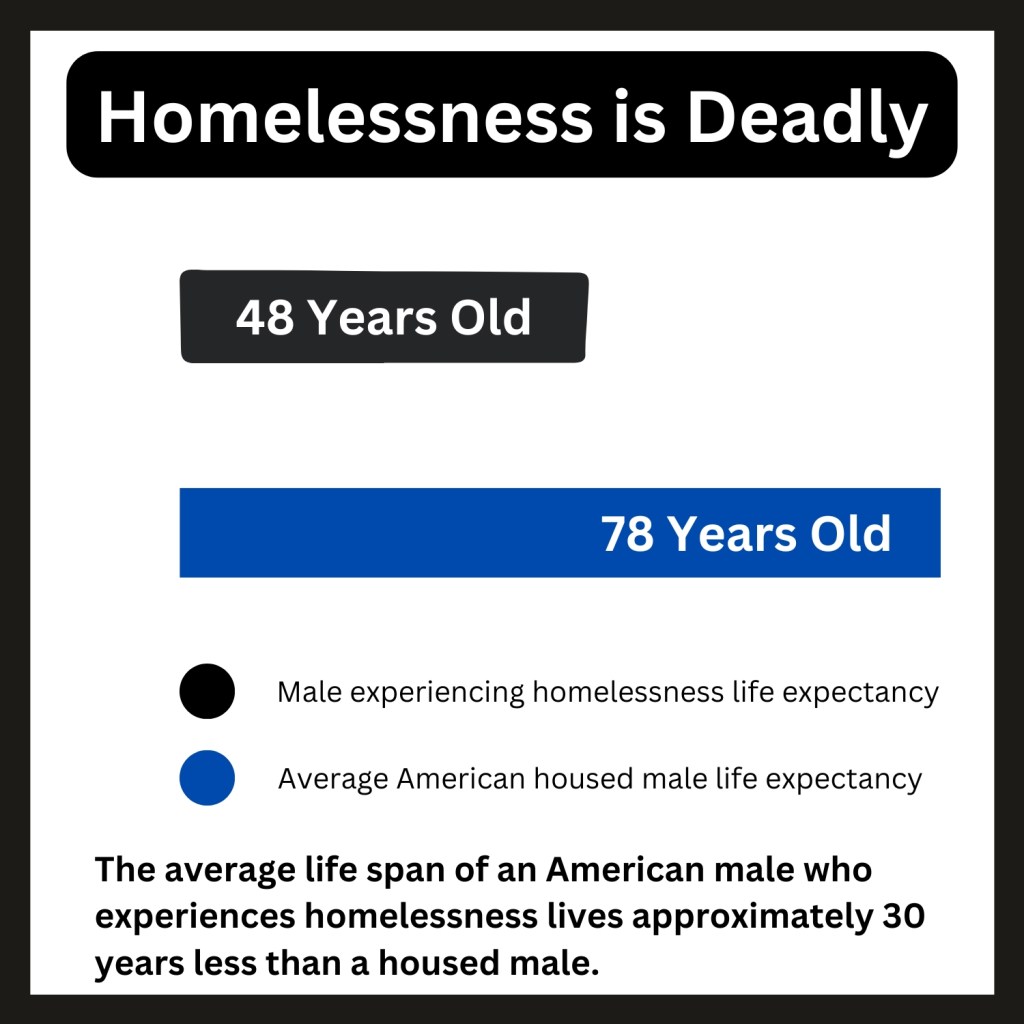
         Three alarming facts about the high cost of homelessness have been discussed recently in a local McMinnville group of homeless service providers and volunteers. Number one: the homeless live about 30 years less than Americans who live in a home. Number two: It cost the taxpayers less to place a homeless person into permanent housing than to keep a person in the Warren County jail for a year. Number three: The homeless are a portion of the self-pay patients who are uninsured or underinsured, costing Ascension Saint Thomas River Park Hospital several million dollars a year in charitable health care.

         Dale Humphrey, President and CEO of Saint Thomas River Park Hospital, informed the group earlier this month that homeless men die about 30 years earlier than their peers who live in a home. Clearly, anyone who lives on the street, under a bridge or in a tent for an extended period of time pays the highest price of homelessness. Being homeless without proper housing is not healthy. While the homeless’ illnesses may not be much different than the non-homeless population, the homeless illnesses are usually much more severe and typically managed worse due to difficulty in cleanliness, nutrition, access to follow up care, and access to proper medication. Humphrey stated that stress is obviously a contributing factor. 

    Dale Humphrey also informed the group that the hospital has $7 million in charitable health care per month, and a significant portion of that charitable health care is contributed to the McMinnville homeless population.

Left to right, President and CEO, Dale Humphrey and Sheriff Jackie Matheny, Jr.

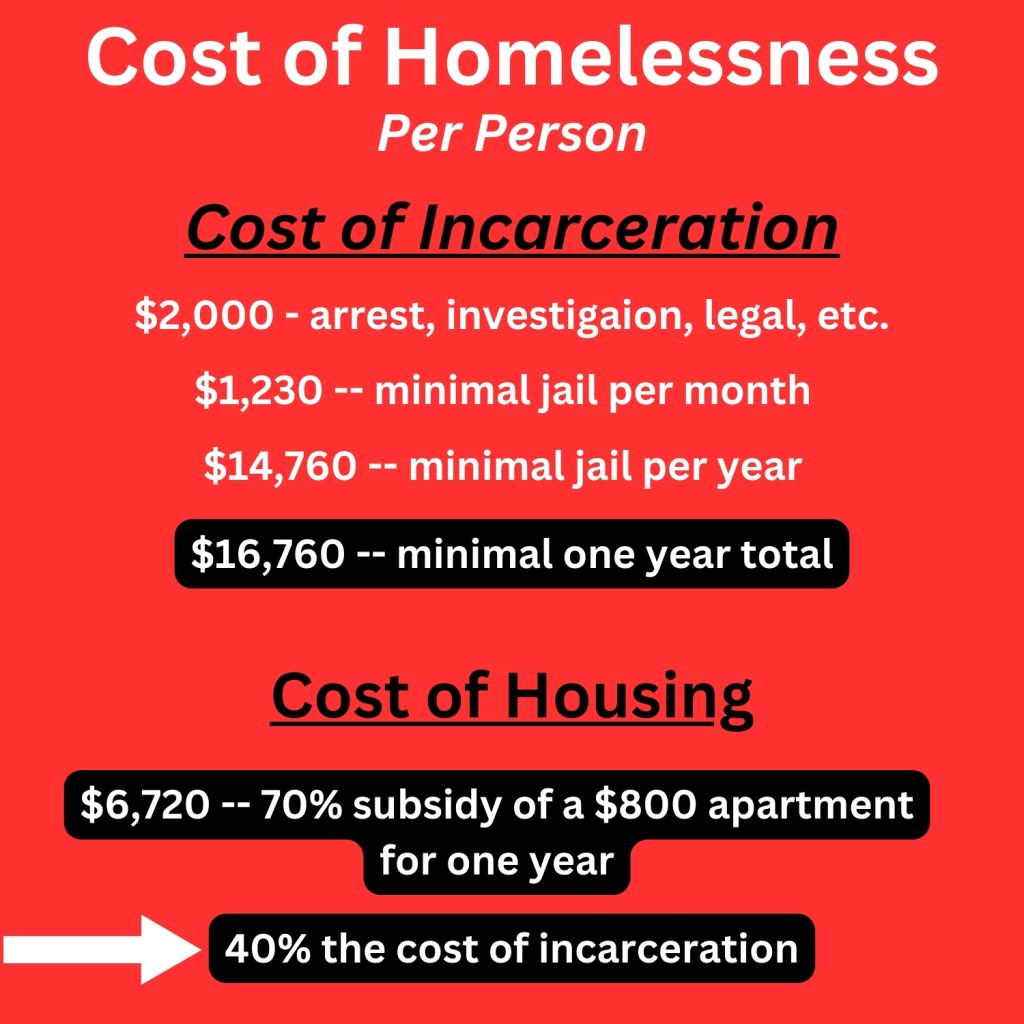
         During the February meeting, Sheriff Jackie Matheny, Jr. spoke to the group and stated that at least 12 of the 258 inmates in the Warren County Jail were homeless. Sheriff Matheny also confirmed that the minimal cost to the taxpayers to keep someone in the local jail is $41 dollars a day. Taxpayers pay more to keep someone in the Warren County jail than taxpayers pay to keep someone in subsidized, affordable housing. See the image below for a detailed illustration.

* The cost of arrest, investigation and legal fees are estimated.

SUBSIDIZED PERMANENT SUPPORTIVE HOUSING…A COST-EFFECTIVE SOLUTION

    A local nonprofit or city/county government can apply for HUD funding to provide permanent supportive housing for the homeless. HUD offers rental assistance that pays 70% of the rent on privately-owned apartments. The subsidy for an $800 apartment would be $560 a month. That is $18.60 per day, which is 45% of the cost to keep someone in the Warren County jail.

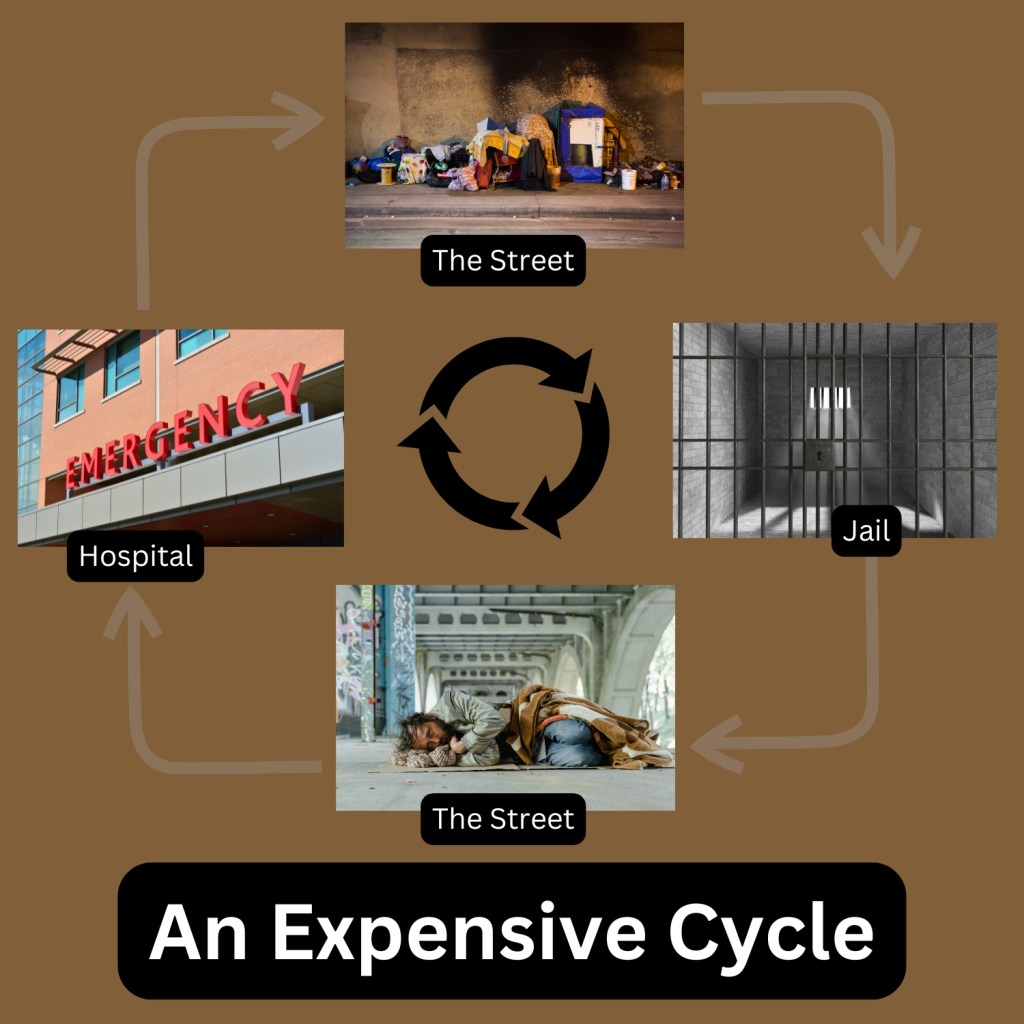
         Common themes from both Sheriff Jackie Matheny. Jr. and Dale Humphrey were the high rates of recidivism and recycling of the same homeless population through the jail and hospital. Placing people who are experiencing homelessness into permanent supportive housing can extend lives — in addition to saving taxpayers and the local hospital a lot of money. All of this begs the question of how to develop a cost-effective solution to homelessness in McMinnville.

BEYOND THE BRIDGE: A POSITIVE SOLUTION TO HOMELESSNESS PROMO

         Readers of this newsletter are encouraged to see the film, Beyond The Bridge. The film is a documentary about solutions to homelessness. The filmmakers traveled over 40,000 miles and studied positive solutions to homelessness. The film highlights solutions in two cities. Beyond The Bridge is showing at Otter Creek Church on West End in Nashville at 6:00 PM on Thursday, April 3. Tickets are free and must be reserved online. This is a link to information about the film and tickets:https://asolutiontohomelessness.com

    Full disclosure, I have been promoting a plan to create affordable housing for 10 homeless people in McMinnville. I am personally looking forward to learning more about positive solutions to homelessness from Beyond the Bridge and the discussion after the film. Nashville Mayor Freddie O’Connell and the filmmakers will be at the event.

         For more information, please attend the monthly homeless meetings in McMinnville. The next meeting will be Friday, April 25, at 11:00 AM, at St. Matthews Episcopal Church.

Five Questions for Attorney Kara Youngblood

Attorney Kara Youngblood

By Brad Durham

         When I grew up in McMinnville many decades ago, there were no “immigrants” that I was aware of in my hometown. As I grew older, I eventually came to the conclusion that almost all of us are “immigrants.” It has become a hot topic recently. Some polls had immigration as a top five issue in last year’s 2024 presidential election.

         Personally, I did not become aware of any new immigrants in McMinnville until the 1980s. There were not any Hispanics living in McMinnville that I was aware of when I grew up here. The last US Census states that 10.1% of the Warren County population is Hispanic or Latino. Link:https://www.census.gov/quickfacts/fact/table/warrencountytennessee/PST045224

         The population has changed over the decades, and I believe that that is a good change. I am very grateful for the vibrant and hard-working Hispanic community in McMinnville. There is one family in particular that has enriched my life tremendously with their friendship and fellowship.

         The campaign and recent rhetoric about immigrants and deportation by President Trump concerns me. The executive order which attempts to end automatic citizenship for babies born on American soil actually shocked me.

         That executive order was blocked and reported by the New York Times on Thursday, January 23: In a hearing held three days after Mr. Trump issued his executive order, a Federal District Court judge, John C. Coughenour, sided with Washington, Arizona, Illinois and Oregon, the four states that sued, signing a restraining order that blocks Mr. Trump’s executive order for 14 days, renewable upon expiration. “This is a blatantly unconstitutional order,” he said.

Link to article: https://www.nytimes.com/live/2025/01/23/us/trump-news#judge-blocks-birthright-citizenship

         To better understand these issues, I asked McMinnville’s immigration expert, Attorney Kara Youngblood, five questions via email. The following are those questions and answers.


BD Newsletter: Please share your perspective on what is happening with federal immigration policies, and do you have a prediction on what the outcome will ultimately be regarding the birthright to citizenship issue?

Kara Youngblood: The implementation of the new immigration policies will likely result in extended processing times, heightened scrutiny of immigration applications, increased discretion granted to immigration officers and prosecutors, as well as a backlog of cases within immigration courts. It is particularly noteworthy that a federal judge appointed by President Reagan issued the injunction. Given the recent rulings by the Supreme Court, it is reasonable to anticipate that the executive order will ultimately be invalidated, even by the most conservative of courts. 


BD Newsletter: Do you foresee any differences between the federal policies/laws and state and local policies/laws? In other words, will federal policies override all local and state policies?

Kara Youngblood: With the recent passage of the state bill that felonizes any vote of an elected official against federal immigration policy it seems like federal may win out. However, it should be noted that both the recent executive orders and this aforementioned state bill are likely unconstitutional and will most likely be immediately challenged.

Under federal preemption law, federal law generally takes precedence over state law if they conflict.


BD Newsletter: How active is ICE (U.S. Immigration and Customs Enforcement) in McMinnville and Warren County? Does this federal law enforcement agency have an office here?

Kara Youngblood: At present, ICE does not maintain an office in McMinnville or Warren County; however, it is anticipated that their presence will increase in the near future, particularly in light of Governor Lee’s initiative to establish a Centralized Immigration Enforcement Division (CIEO). Gov. Lee’s agenda also aims to incentivize local governments to collaborate in the enforcement of federal immigration policies and allocate funding to support both federal and state immigration efforts. Additionally, we can expect an expansion of ICE activities, particularly as ‘sensitive’ areas, such as schools and places of worship, are no longer protected under the same restrictions. Since 2011, such locations were considered ‘sensitive’ and were off-limits to ICE raids except under specific, limited circumstances; however, under the previous Trump administration, these areas were no longer classified as ‘sensitive’ and thus are now subject to enforcement actions.


BD Newsletter: What would you advise an immigrant who is not a U.S. citizen and living in McMinnville to do, in addition to contacting your office for legal consultation?

Kara Youngblood: Know your rights and if you are here lawfully, be sure you keep proof of that with you. We have created a “Know Your Rights” campaign on the Youngblood & Associates social media platforms that will be published over the next few weeks. Keep an eye out for those.


BD Newsletter: What percentage of your clients live in McMinnville and Warren County?

Kara Youngblood: I cannot answer this question. I believe Tenn. Sup. Ct. R. 8, RPC 1.6 would apply in this instance which prohibits me from sharing client information individually or collectively without their consent.


Bonus Question: What motivated you to practice immigration law?

Kara Youngblood: My father has owned and operated a nursery in Morrison my whole life. The immigrant population is an integral part of the agricultural industry. I was exposed to the immigration system from a young age, seeing the vast expanse of how immigration shaped the lives of those that worked side by side with my father, and who ultimately became like a part of our family. From the positive impacts of the green card and naturalization processes to negative consequences of immigration detentions and deportations, I was privy to a world that most US citizens never see. I found the complexity of this facet of the law interesting and knew the positive impact I could have for many people if I studied it and offered solutions to the many qualified individuals that simply needed someone on their side to navigate the complex system for them.

I always say that unlike many other types of law, no one loses when I win a case. Most of my clients have already positively integrated into our community, but my services allow them to finally do so out of the shadows and with the peace of mind that every person deserves. 


Attorney Kara Youngblood in her office.

BD Newsletter Footnote: The following is a brief overview of Kara Youngblood’s professional career.

         Kara Youngblood is the founding attorney of Youngblood & Associates, which is dedicated to providing legal immigration services to individuals and families and labor solutions for green industry employers. Website: www.youngbloodassociates.com

         Youngblood is also the owner of The Local on Morford restaurant, which is part of the major renovation projects she has undertaken on Morford Street. Kara Youngblood was elected to office as a City Alderman in 2024 and is chairman of the Building & Grounds committee. She also serves on the Tourism & Marketing, Parks & Recreation, and Water & Wastewater committees.

         Youngblood was Valedictorian of her Warren County High School senior class, Middle Tennessee State University, Bachelor of Science, and The University of Memphis—Cecil C. Humphreys School of Law, Juris Doctor, Law.

DOWNTOWN SHELTER NEEDS VOLUNTEERS

By Brad Durham

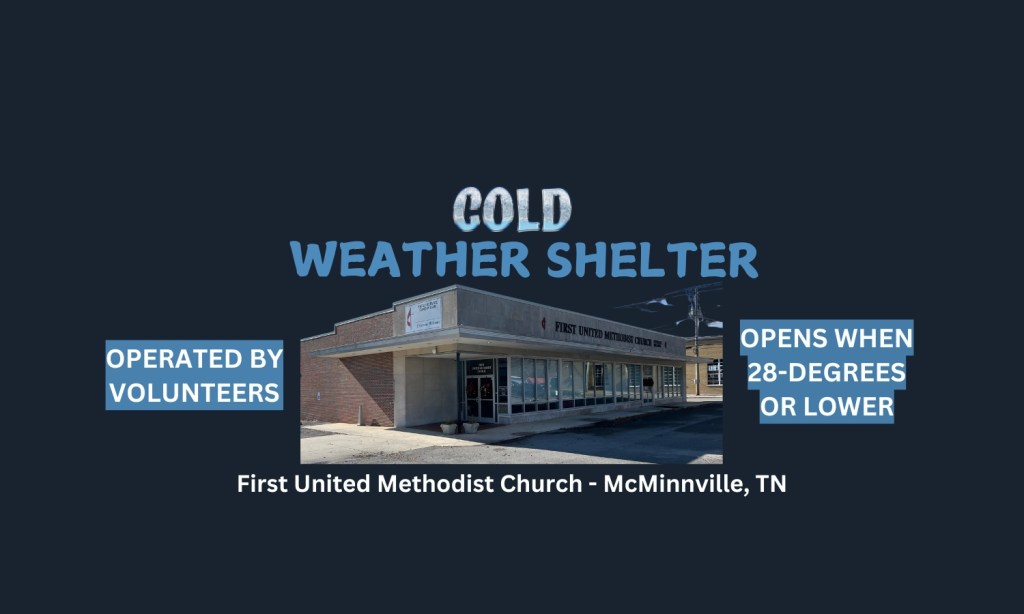
First United Methodist Church, St. Matthew’s Episcopal Church and H.O.M.E. are collaborating to provide a men’s shelter during cold weather at First Methodist’s Outreach Building. The staff is maintained by volunteers, and volunteers are needed to stay overnight with the guests. A signup link is below.

Link to signup to volunteer: https://www.signupgenius.com/go/70A0444ACAA2DAB9-54174785-coldfbclid=IwY2xjawHqXfZleHRuA2FlbQIxMAABHQhnXlkEqY5EM0GPdFgvtXlViplwYZsAffyVnlcEenqxfpBsdyKeWTEhHw_aem_E92inJlT5pNOrh5mTOtUjg#/

Registering at the link above with SignUpGenius will take only 5-10 minutes.

If you wish to speak with anyone about volunteering, please call First United Methodist Church at (931) 473-4419.

Volunteers will be asked to sign a code of conduct form and stay at the shelter from 8:30 PM to 7:30 AM.

GENERAL INFORMATION

The McMinnville Cold Weather Shelter for men will open on a contingency basis – based upon two factors. When the temperature is 28-degrees or below (or 25-degree wind chill factor), the Cold Weather Shelter will open. The other factor will be if there are a sufficient number of volunteers to operate the overnight shelter.

McMinnville First United Methodist Church is hosting the McMinnville Cold Weather Shelter for men only from 6:00 PM to 7:30 AM. This is a collaboration with St. Matthew’s Episcopal Church, HOME and volunteers.

Please spread the word so that any male person experiencing homelessness in McMinnville and Warren County will have the opportunity to come inside during severe cold weather.

If you or anyone you know wishes to volunteer, please have them contact First United Methodist Church at (931) 473-4419.

The Collective Failure to Help Sable Winfree

By Brad Durham

       The sad truth is that if people in administrative positions at Warren County High School and the central office had performed their jobs properly, Sable Winfree would still be on the WCHS Lady Pioneer basketball team. The purpose of educational athletics (high school sports) is to use teamwork that contributes to a common goal. Ideally, coaches use sports to transform lives. 

       Joe Ehermann is an author and former professional football player. He has been a high school coach, and has spoken about the power of being a positive coach versus a negative, transactional coach who only focuses on his/her own agenda. The TSSAA worked with Ehrmann in conjunction with a grant from the NFL for approximately three years. His book, InSideOut COACHING has been used to inspire coaches. Ehermann described a coach in the book:

       An InSideOut coach resists the transactional impulse and asserts that the right way, indeed the only way, to coach young people is to seek to transform their sense of their own worth, talents and value.

       What could have been an educational and transformative experience for Sable Winfree became an unnecessary tragedy.

Cannot Write Everything That I Have Heard

There are many things that I have learned about Mendy Stotts and certain members of the administration that I have not reported in this newsletter. Some people do not want to go on the record because they do not want to deal with the complexities of being confrontational. Some people are afraid of retaliation by the head coach and members of the administration. Consequently, I cannot write everything I believe to be true involving the dismissal of Sable Winfree from the Warren County High School Lady Pioneer basketball team.

The First Administrative Mistake

       Based on what I have been told and learned, the first mistake was not properly vetting Mendy Stotts before she was hired. The hiring process at the high school involves the head principal, Chris Hobbs making a recommendation to Dr. Grant Swallows, who actually makes the hire. Todd Willmore was the athletic director when Stotts was hired. 

       Two factors make me wonder why Mendy Stotts was hired. One is a rumor that keeps swirling around McMinnville that Stotts exhibited some strange behavior after being dismissed from Anthony Lippe’s staff in 2019. The other factor is the number of parents who have complained about how Stotts treated their daughters at the middle school. The present administration has to know that several of those complaints have been echoed by parents at the high school. 

       I have heard from a parent who took a daughter out of the Warren County School system after Stotts was named head coach at WCHS. I believe there are other parents who made changes after Stotts was named head coach. Several high school parents met with Stotts before the season started to express concerns about her behavior toward their daughters. Several parents have also met with WCHS administrators to express their concerns during the season.

       As recently as last Monday, December 4, a principal went into the Lady Pioneers’ locker room after the loss to York. Allegedly, Stotts was screaming at players in the locker room. Stotts was not present afterwards for an interview that Jay Walker conducts on the radio. 

       Apparently, Mendy Stotts was not the first choice to become the new WCHS Lady Pioneer head coach this past spring. If that is true, maybe the administration believed that they had no other choice but to hire Stotts. How has that worked out for the Lady Pioneers?

Another Administrative Mistake

       A clear sign of the administration’s attempt to bury and whitewash the dismissal of Sable Winfree from the team is the investigation of a formal complaint. Soon after Sable Winfree’s dismissal, her mother filed a complaint against Mendy Stotts with the new Human Resource Director for Warren County, Todd Willmore. Conducting a professional investigation for a novice HR Director must be challenging. The report, whether by design or from a lack of training and experience, is not credible. 

       For example, Mr. Willmore reported, “We were unable to find any derogatory statements made by coach Stotts about Sable…” Was Chris Hobbs questioned during the investigation? Mr. Hobbs clearly heard coach Stotts make “unsubstantiated” derogatory statements about Sable during the meeting in which Sable was dismissed from the team.

Trying to Control the Narrative

       One school board member told a citizen to go complete a form and get on the December 4, school board agenda regarding Sable Winfree’s dismissal from the team. The citizen completed the form as suggested, and was kept off the agenda, allegedly by the Director of Schools. 

       The funny thing is that the day after the meeting, the Director of Schools, Dr. Grant Swallows called that citizen to discuss the dismissal of Sable Winfree. That citizen was in the school board meeting, but none of the school board members, the Director or school attorney chose to discuss the dismissal of Sable Winfree during the meeting. Yet, comments have been made outside of the board meeting.

Leaks from the Administration and Central Office Staff

       Meanwhile, what keeps leaking out of the high school and central office are comments such as these, “We cannot comment on the reasons Sable Winfree was dismissed from the team. We are trying to protect her. Some parents are happy she is not on the team. If we mentioned what she has done, she would never play basketball again.” These statements are either false or half-truths to deflect from the real issue – the administration is trying to support Mendy Stotts’ strange decision to dismiss Sable from the team.

An Abundance of Disregard for Sable Winfree

       Instead of working collectively to transform Sable Winfree’s sense of self-worth, talents and value, the people entrusted with the responsibility of mentoring Sable have trashed her reputation. The assault on Sable’s character is also an attempt to diminish her achievements as a high caliber basketball player. During the past three years, Sable was “Freshman of the Year” in the district and All-District her sophomore and junior years. 

       Mendy Stotts, Chris Hobbs, Todd Willmore and Dr. Grant Swallows all knew that Sable Winfree had been offered a college scholarship to play basketball. They also knew that Sable Winfree decided to stay at Warren County High School and not move to Sparta with her mother this summer. Everyone knew that Sable’s senior year was her year to play basketball and work to expand her college offers. Because of the mindless dismissal of Sable from the team, she has no college scholarships. 

       There are so many different ways the head coach could have handled her problems with Sable. Incredibly, Stotts is a school counselor at the high school. It is beyond comprehension that the coach, athletic directors, principals and Director of Schools could not have put all their brain power together to find a better solution for Sable Winfree and the Lady Pioneer basketball team, which is now 1-8.

Lack of Courage

       Someone inside the Warren County School System should have had the courage to stand up for Sable Winfree. Principals, athletic directors, school board members, coaches and the Director of Schools may have good hearts and an authentic desire to help students. Nonetheless, when the time came to stand up for Sable Winfree, they became deaf, dumb and blind. They failed her.