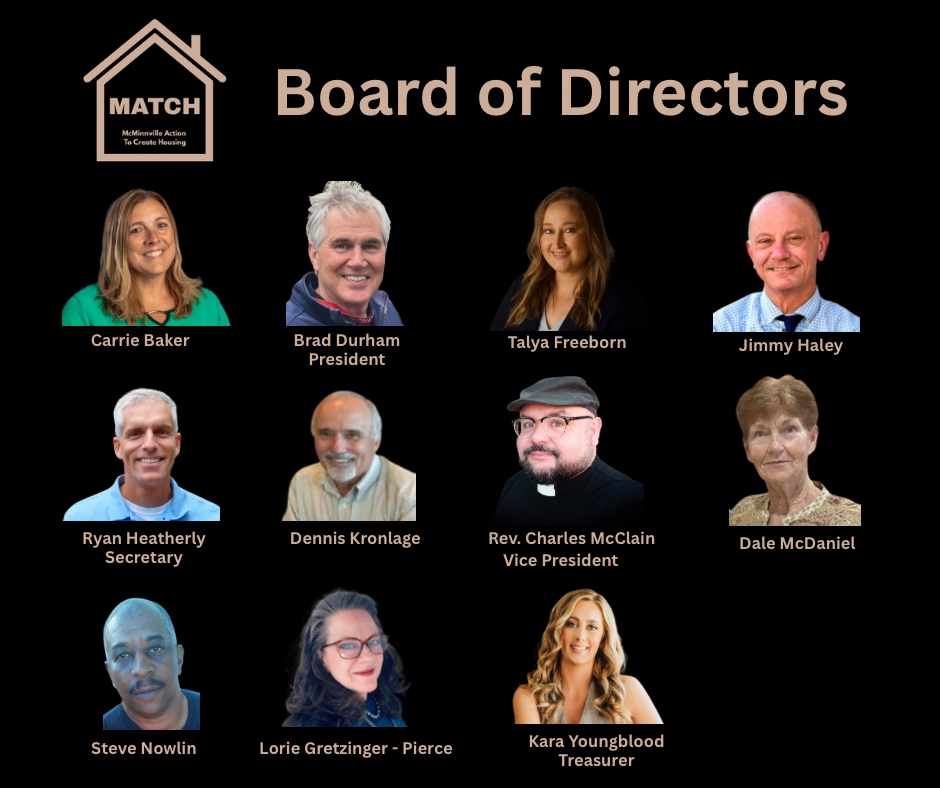
Recently, the McMinnville Action To Create Housing (MATCH) hosted the documentary film Beyond The Bridge at the Park Theater on January 22, 2026. I founded MATCH and invited people to join the Board to assist the poorest of the poor in McMinnville—our homeless neighbors. My vision for MATCH is to operate as a 100% volunteer effort focusing on three areas: advocacy, managing resources, and developing programs.
OUR FIRST ACTION
Our first action as a nonprofit was to advocate publicly for permanent supportive housing for the unhoused in our county by presenting the film Beyond The Bridgeand hosting a Town Hall Meeting afterward. What is permanent supportive housing? It is an evidence-based solution to homelessness that quickly places a homeless person or family into an apartment, usually owned by a private landlord. Two key components are the supportive services that follow the individual into permanent housing and a rental subsidy that helps address the issue of housing affordability.
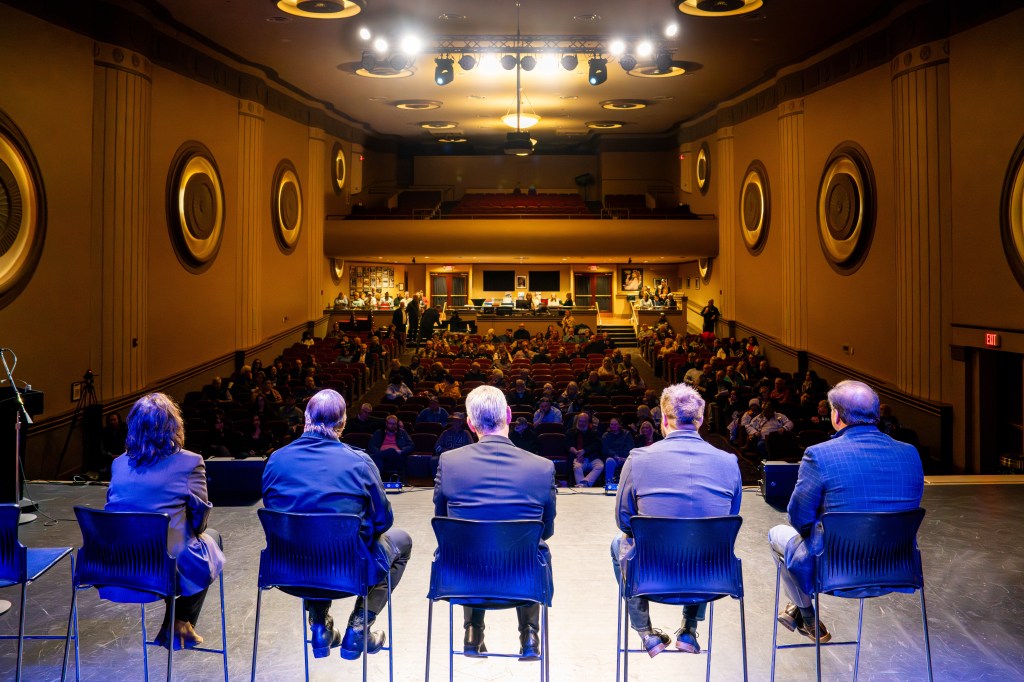
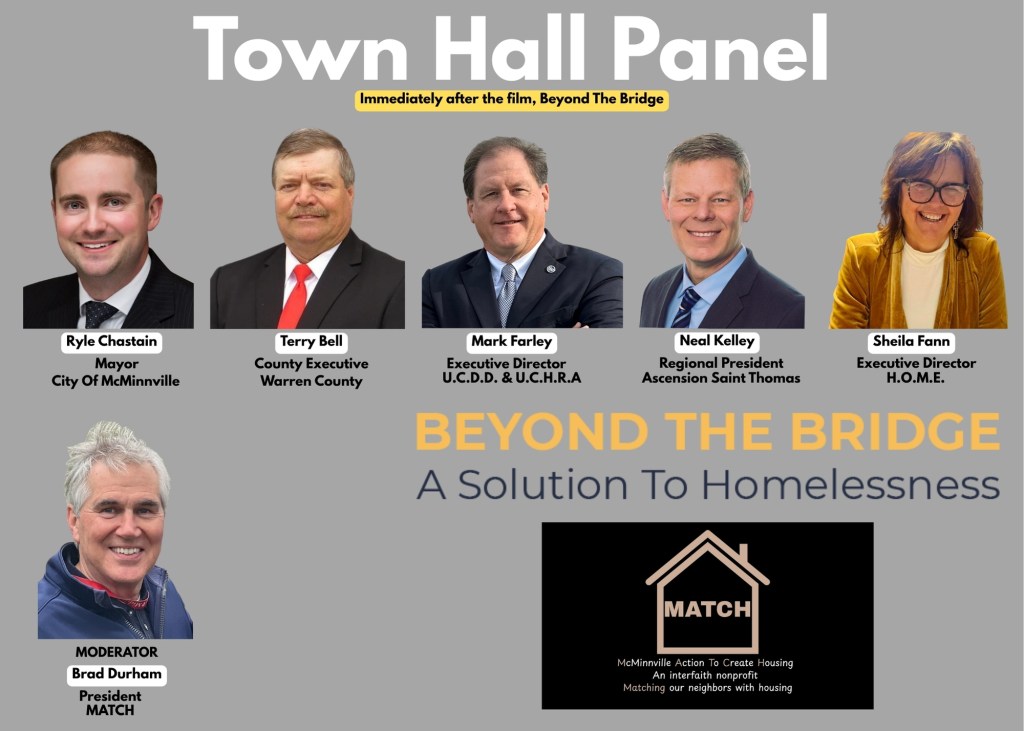
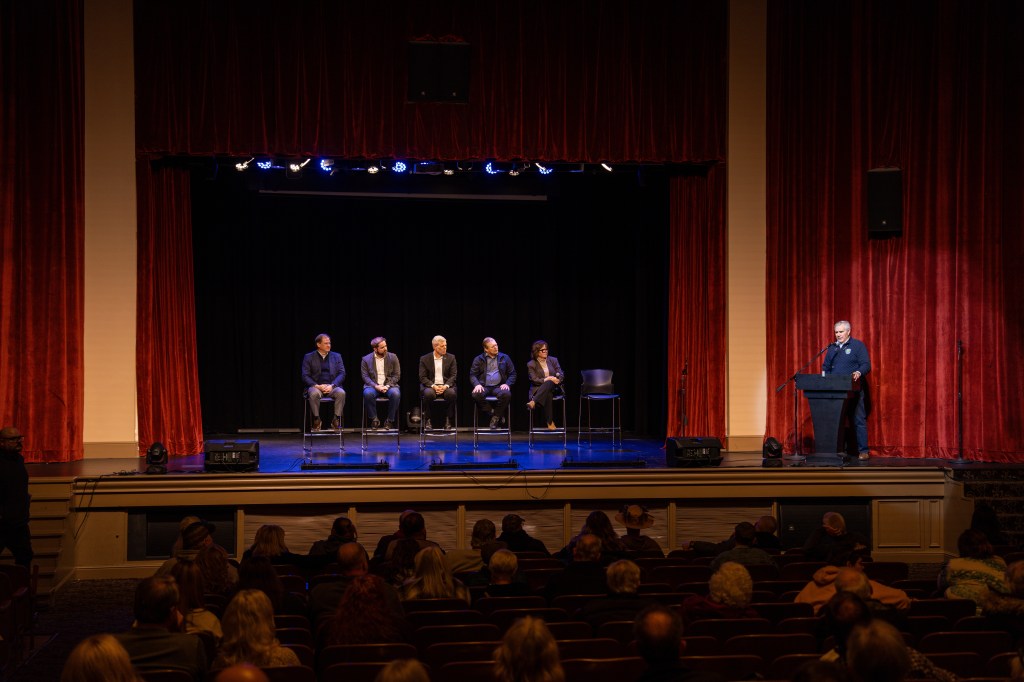
The Town Hall Meeting featured City MayorRyle Chastain, County Executive Terry Bell, UCDD/UCHRA Executive Director Mark Farley, Regional President of Ascension Saint Thomas Neal Kelley, and Sheila Fann, the Executive Director of HOME. I served as the moderator in my role as president of MATCH. Ninety percent of the questions came from the audience of 250 people.
ROUNDTABLE
The clear message from the Town Hall Meeting was that the mayor, county executive, executive director of UCDD/UCHRA, and the regional president of Ascension were all interested in sitting at a roundtable to develop and implement a public policy for creating permanent supportive housing. MATCH successfully advocated for permanent supportive housing in a forum that was free and open to everyone in McMinnville.
Town Hall Meeting after Beyond The Bridge. Panel and Moderator.
SPONSORS – SUPPORTERS
Our presenting sponsor, Ascension Saint Thomas River Park, donated $10,000 to help us create awareness and foster community involvement. Other sponsors included Ben Loman Connect, Security Federal Savings Bank, Youngblood and Associates, The Local, St. Matthews Episcopal Church, First United Methodist Church, the Southern Standard, and over 100 private citizens. Roland Advertising provided free billboard promotion for the event.
TWO OTHER POINTS OF FOCUS
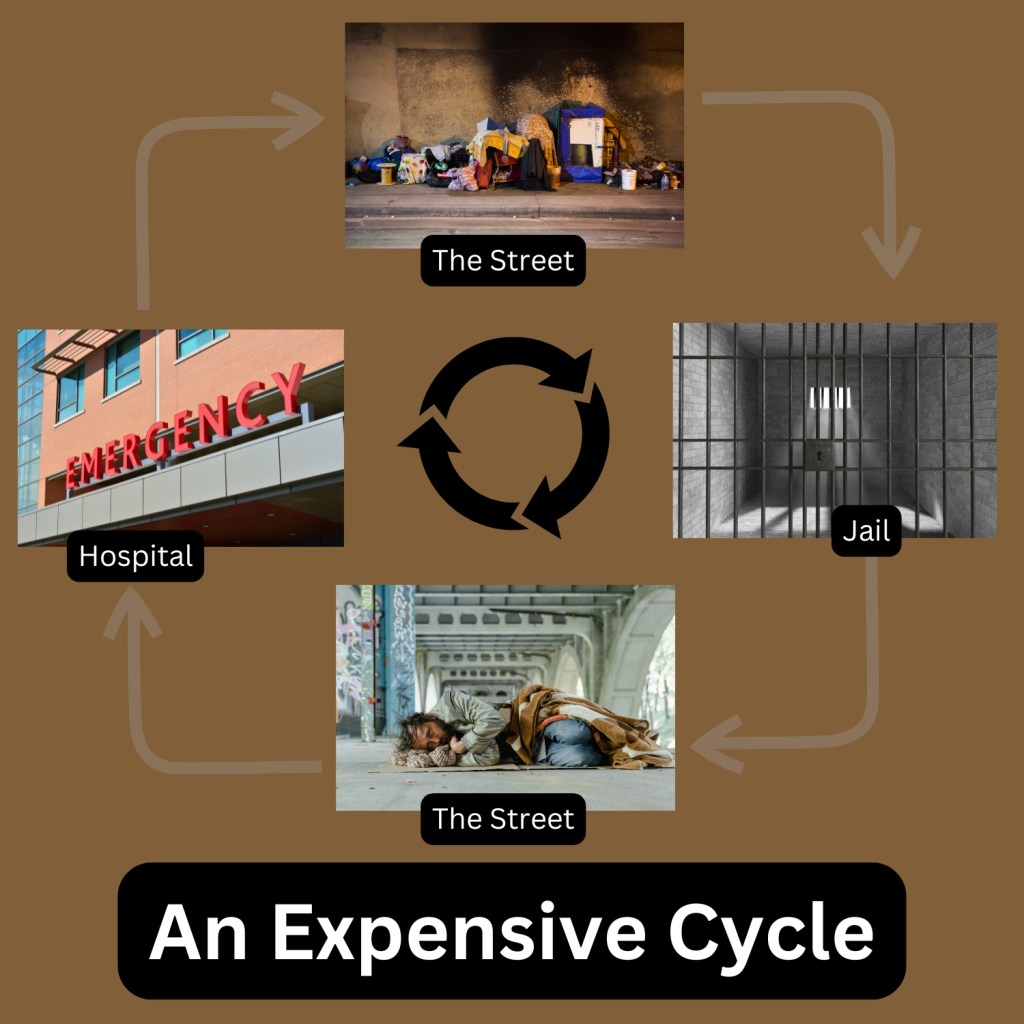
MATCH has two other major focuses: resource management and program development. These are issues we wish to discuss at the roundtable with elected officials, regional and local service providers, business leaders, and private citizens. We have met individually and as a group with our police chief, the sheriff, the District Attorney, public defenders, and judges to discuss collaboration in addressing the disproportionate burden our unhoused neighbors create in these areas. There is a term often used to describe the pattern that the homeless follow—from hospitals to law enforcement, to courts, and then to jail—known as “frequent fliers” or “frequent users.”
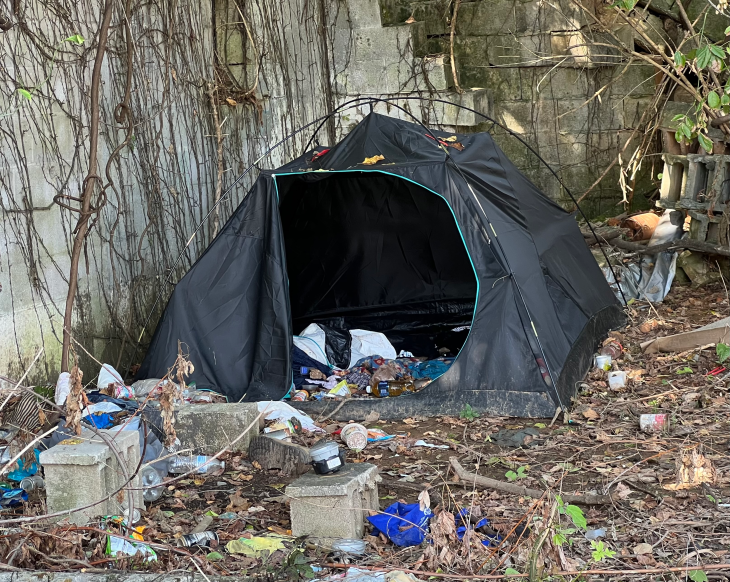
Tent in Downtown McMinnville during the past two years…
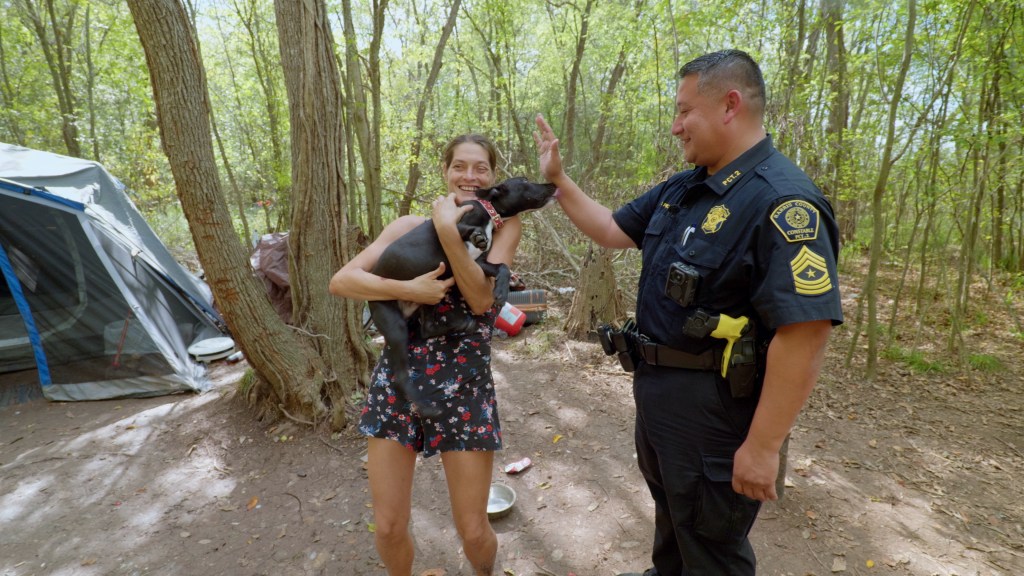
Scene from Beyond The Bridge – Houston police outreach worker to the homeless.
CONSERVE PUBLIC RESOURCES
MATCH aims to conserve limited public resources by leading our homeless frequent users from this cycle by helping them transform into permanent supportive housing. To achieve this, we need to manage funding resources at the local, regional, state, and federal levels to develop full-time staff who can assist the homeless in navigating their way to permanent supportive housing.
Various levels of funding to support permanent supportive housing.
REPLICATE THE DOCUMENTARY FILM
If we had presented a great science fiction film like Star Wars by George Lucas and said we wanted to replicate the Rebel Base and Storm Troopers in McMinnville, you would think we were crazy! Yet, we showed a documentary film presenting an evidence-based positive solution to homelessness at the Park Theater and expressed our desire to replicate it in McMinnville.
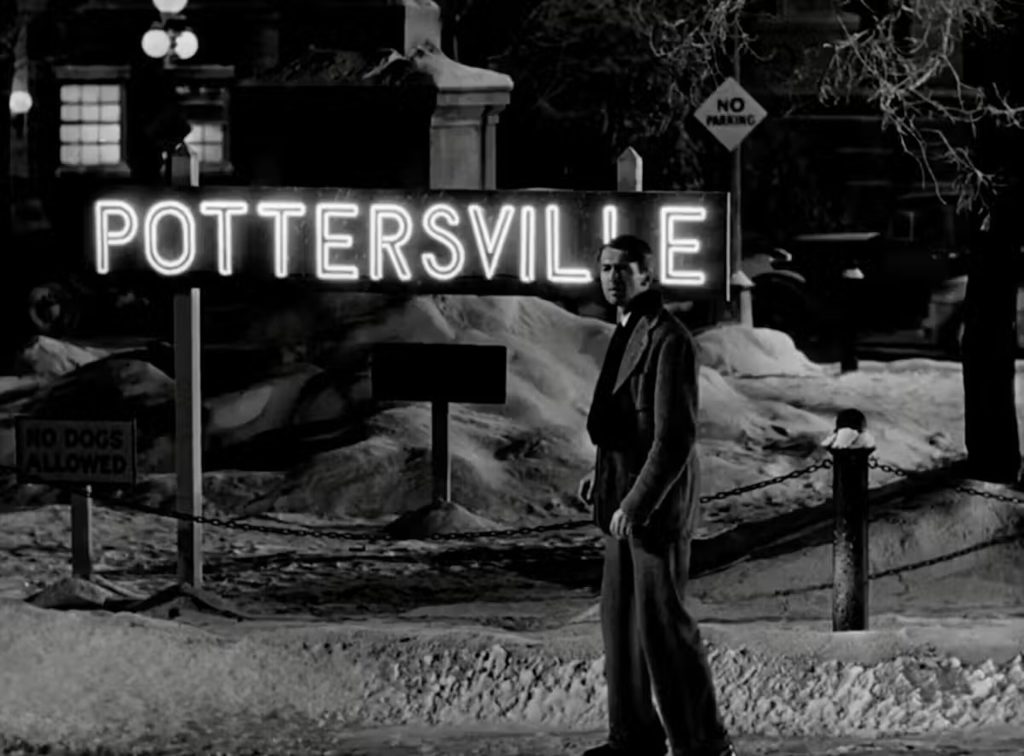
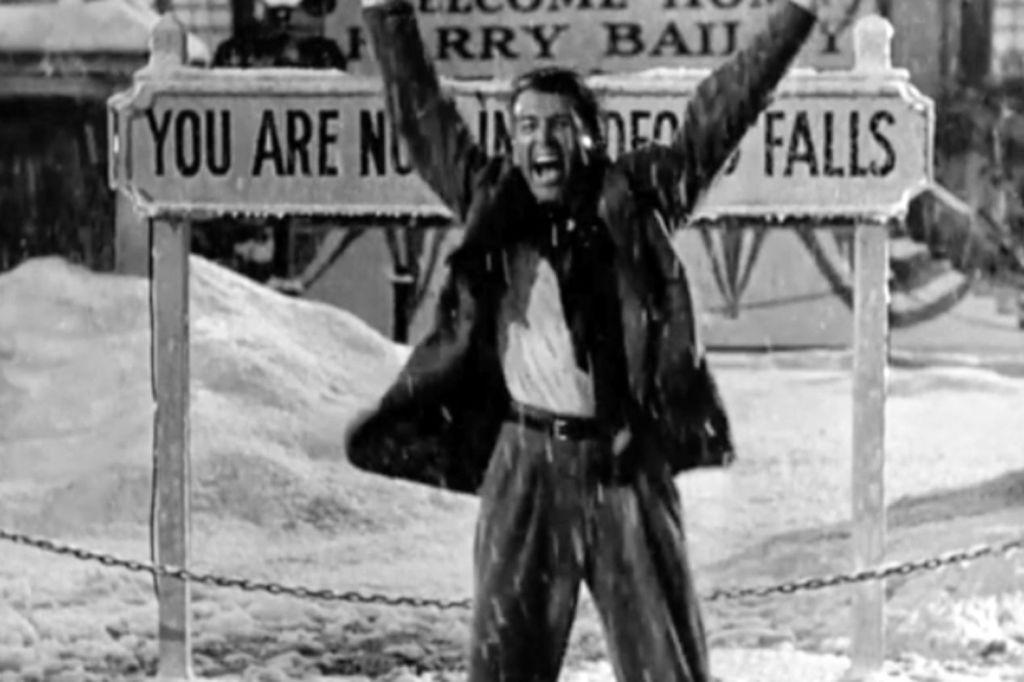
BEDFORD FALLS VS POTTERSVILLE
Let me use another film analogy: Frank Capra’s It’s A Wonderful Life, which many of us enjoy watching each Christmas. I am asking everyone throughout McMinnville and Warren County: Do you want McMinnville to be a Pottersville or a Bedford Falls?
CALL TO ACTION
There is something each of us can do to support the poorest of the poor in our community. You can become a positive advocate for permanent supportive housing, contribute your skills, resources, and compassion to help.
Watch this video and contact MATCH if you want to be part of the solution to homelessness in McMinnville by helping develop permanent supportive housing for our homeless neighbors.
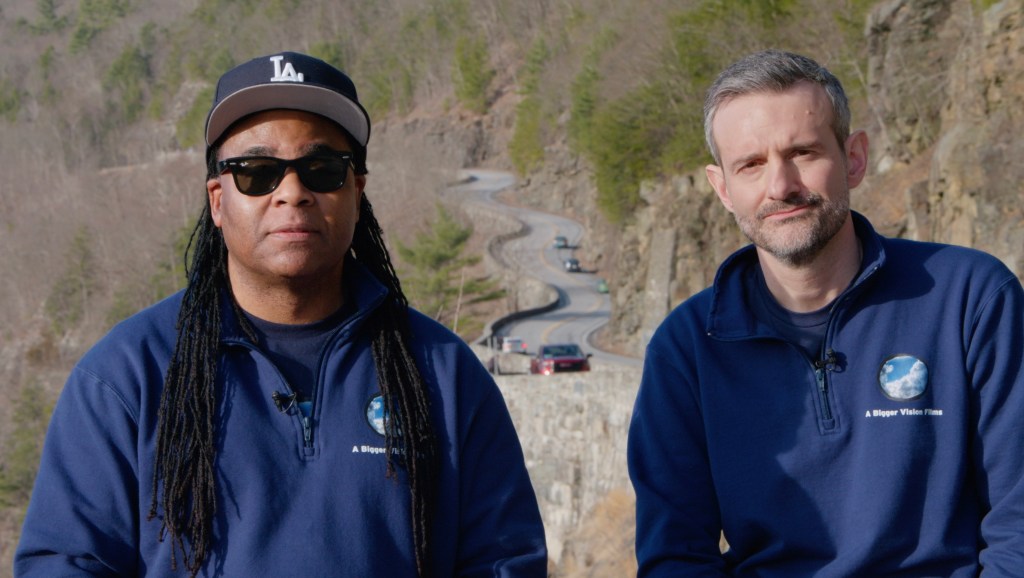
MATCH (McMinnville Action To Create Housing) is bringing the film, Beyond The Bridge to the Park Theater on January 22, 2026. A Town Hall Meeting will take place immediately after the film. The filmmakers, Tim Hashko and Don Sawyer will be in McMinnville the day of the film and at the screening for various meetings. This interview serves as an introduction to them and their experiences in making the film.
BD Newsletter: Why did you make the documentary film, Beyond The Bridge?
Tim Hashko and Don Sawyer: Most documentaries about homelessness focus on how sad, lonely, and what a pathetic state people experiencing homelessness are in. This is true. But what needs to happen to fix the situation? We thought that if America can successfully keep a space station orbiting the earth for many years now, America can also successfully solve homelessness. We just didn’t believe solving homelessness is beyond the capability of this country, so we set out on a journey to discover the solution for ourselves.
BD Newsletter: What is the most common reason towns have not developed a strategic plan to solve homelessness? What is the common denominator in these towns?
Tim Hashko and Don Sawyer: There are two very common reasons communities struggle when it comes to creating an effective strategic plan to address homelessness. First, in most communities, there is a deep, unspoken belief that homelessness is an intractable problem that can never be solved. If you don’t believe you can solve the problem, then you will never solve the problem – a fundamental principle when pursuing any goal. Second, most communities (sometimes inadvertently) set their homeless response systems up to serve their local government, service providers and the housed public. In other words, the welfare of these groups are prioritized over the welfare of the people experiencing homelessness. For many communities the priority of their homeless response system is to get the homeless population out of sight and out of mind instead of meeting them at their need and leading them out of homelessness – when this is the objective of a homeless response system, it will always end in failure.
Have you seen a difference in the approach and resources committed to solving homelessness in small and large cities? In other words, have you seen small towns practice the same plans large towns use?
Tim Hashko and Don Sawyer: The scale is different, but the fundamentals are the same. Large cities tend to have more resources and more complex systems, while small towns often assume those models do not apply to them. What we found is that the core strategies that work in big cities also work in small communities when they are adapted to local conditions. In fact, small towns often have an advantage because relationships are closer and change can happen faster.
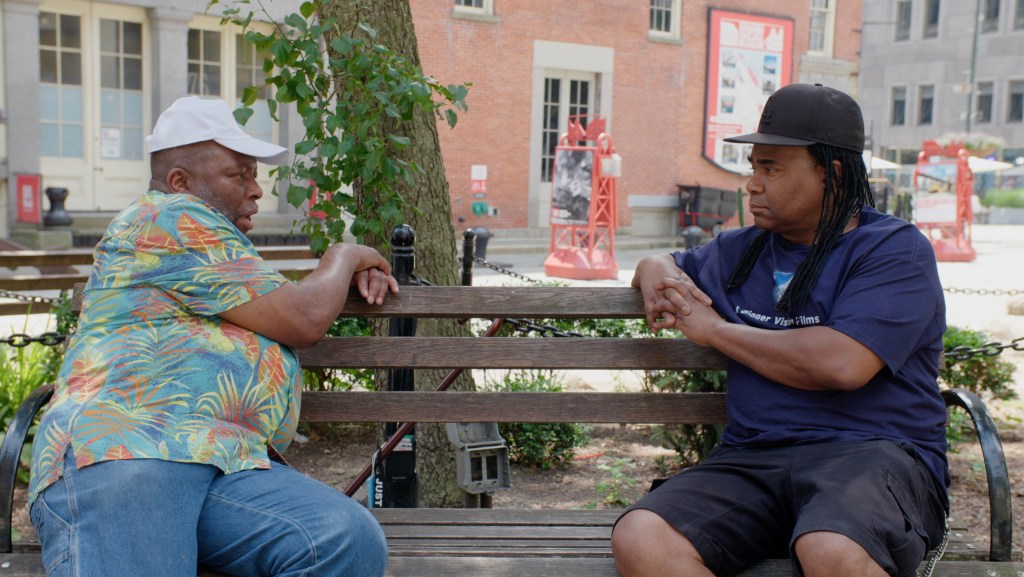
Don Sawyer interviewing Rob Robinson, a prominent community organizer, activist and formerly homeless.
BD Newsletter: What is the number one reason you want people to see your film?
Tim Hashko and Don Sawyer: To change perspectives on people experiencing homelessness, and to learn why homelessness exists in this country. Then, we want people to see that homelessness is solvable by deploying the blueprint we show in the film, which applies to every community no matter how big or small a community is. Ultimately, we’d like people to understand that if they want different results in their efforts to address homelessness, they will have to band together as a community to make it happen – everyone has a role.
BD Newsletter: Why should a private citizen, service provider, business person, and elected officials see this film? On the other hand, is there anyone in McMinnville who should not see Beyond The Bridge?
Tim Hashko and Don Sawyer: Homelessness affects the entire community, and solutions require participation from everyone. The film gives private citizens a clearer understanding of what actually works, service providers a framework for stronger collaboration with other organizations, business leaders insight into how they can help, and elected officials examples of effective leadership grounded in results rather than theory.
There is no one who should not see this film. It is not political and it does not promote a single ideology. It presents evidence, lived experience, and real world solutions, and invites the whole community into a more productive conversation.
Please plan to attend this event—admission is free! By reserving a ticket, you’ll secure your spot and receive a convenient reminder, ensuring you don’t miss out on this exciting experience. Click on the link below to reserve your ticket today.
AUTHOR, STREET CHAPLAIN, ACTIVIST & NONPROFIT LEADER
LINDSEY KRINKS
BY BRAD DURHAM
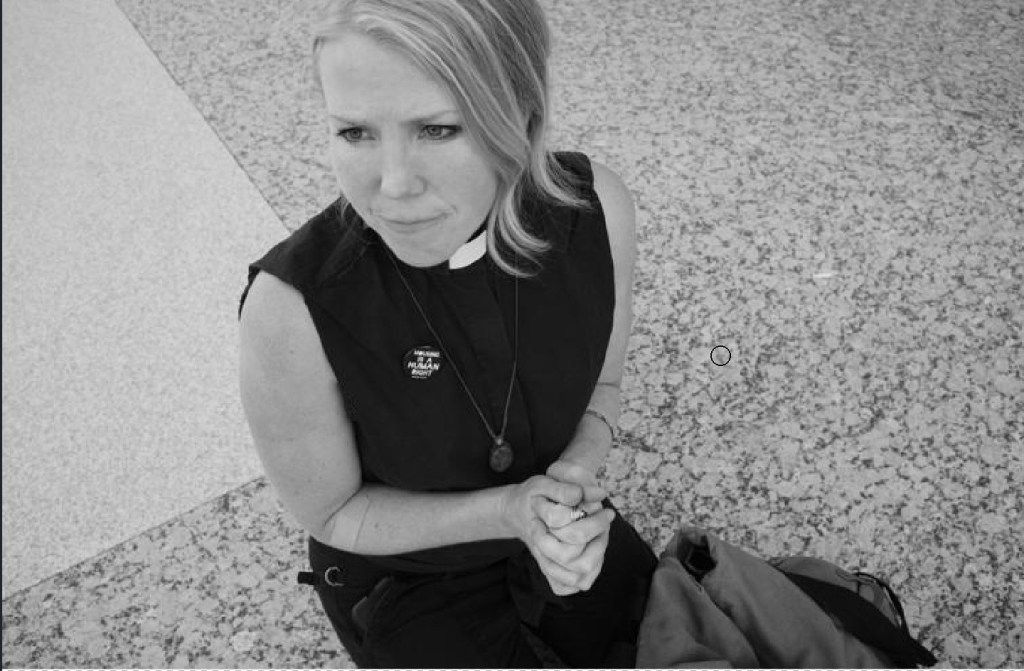
Recently, Lindsey Krinks visited McMinnville and spoke to a group of people working with unhoused individuals in the community. Not only did Krinks travel 70 miles to reach McMinnville, but she has traveled a great distance in her lifetime—going from South Carolina to David Lipscomb University, then to Vanderbilt Divinity School. She has made her way from Tent City to Otter Creek to Legislative Plaza. Throughout her journey, she has undergone transformative experiences rooted in a spiritual quest.
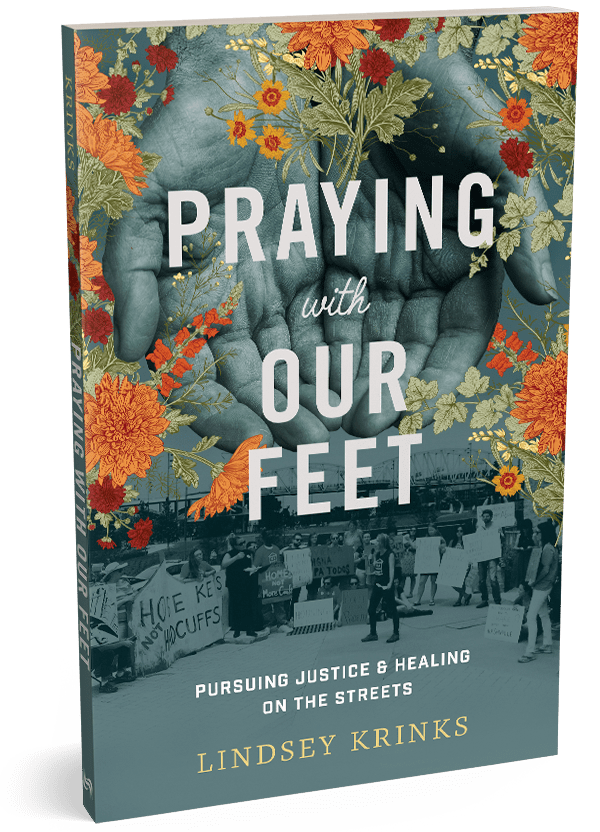
After inviting Lindsey Krinks to meet with us, I read her book, Praying with Our Feet. As I read her autobiography, I couldn’t help but think of Joseph Campbell’s Hero’s Journey. The hero embarks on an adventure beyond the ordinary and returns with a message. Lindsey’s story mirrors this: she has faced moments of almost breaking down physically, mentally, and spiritually—yet she persevered and was transformed. Her drive to serve the poorest of the poor—the homeless—has fueled her journey.
For me, reading Lindsey’s book felt like uncovering stories of saints such as Saint Francis of Assisi and Mother Teresa—people who led lives of profound transformation and became signposts along the journey of imitating Christ.
Lindsey Krinks is the real deal—she is a street chaplain, author, activist, and nonprofit leader. She is the co-founder of Open Table Nashville. I’m grateful she visited us to share her story and an excerpt from her book, Praying with Our Feet.
After the meeting, I asked Lindsey a few questions. The following is part of that interview during lunch at The Local in McMinnville.
BD NEWSLETTER: What motivated you to work with the homeless?
LINDSEY KRINKS: Growing up, members of my family—their experiences with homelessness—shaped my perspective. My cousin and uncle experienced homelessness, and I initially thought it was a personal decision on their part. But when I got to college in Nashville, I realized that poverty is much more widespread than individual choices. I started re-reading the Hebrew prophets and the Gospels, and a conviction grew in me: if we are truly followers of Christ, we must go where Jesus went. We are called to the margins—to love, to extend our hand, share food, and provide shelter. And if we take Matthew 25 seriously, we are also called to find Christ there.
Understanding how widespread and systemic the problem is—beyond personal failures—has deepened my call to be the hands and feet of Christ. Compassion at this larger level is justice. That’s a significant part of what pulled me into this work. But once I built relationships with people on the street, I was amazed by who they are and what they had survived. After forming those relationships, there was no way I could go back to anything else. It has been the most raw, real, and transformative experience I’ve ever been part of.
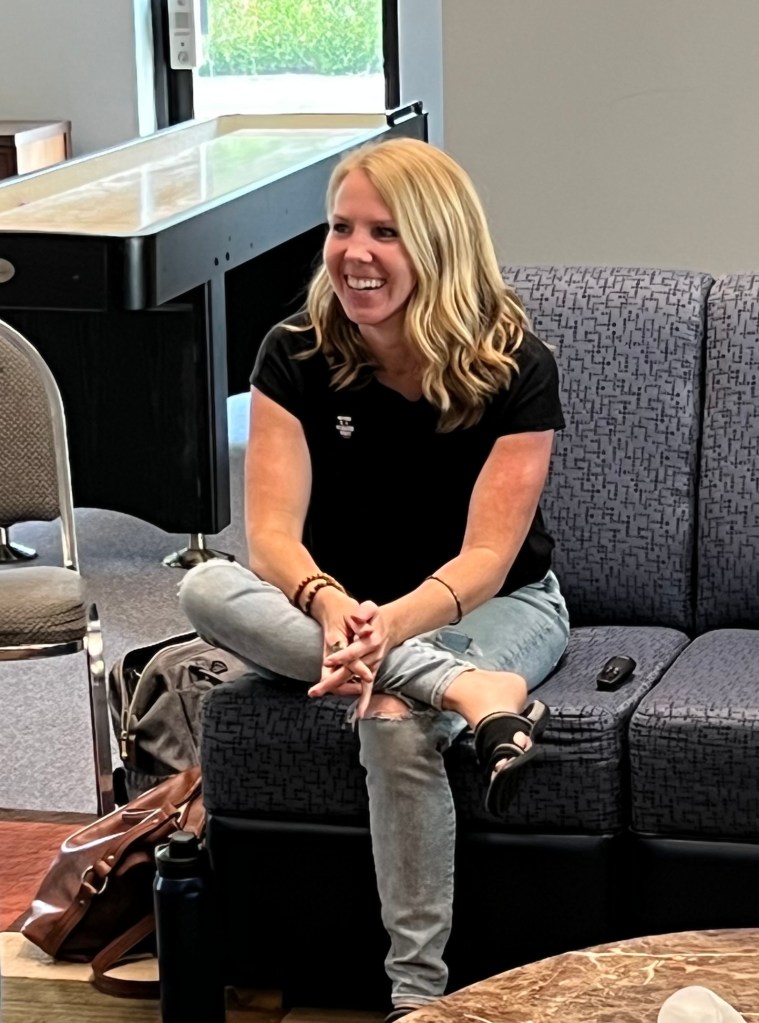
LINDSEY KRINKS SPEAKING IN MCMINNVILLE, JUNE 20, 2025
BD NEWSLETTER: What influenced you to attend Vanderbilt Divinity School after graduating from David Lipscomb University?
LINDSEY KRINKS: I started becoming involved with issues of homelessness and affordable housing during my time at Lipscomb. Influences included dedicated teachers, books I was reading, and a service club that truly changed me.
I was introduced to authors like Shane Claiborne (The Irresistible Revolution), Dorothy Day (The Long Loneliness), and saints such as St. Francis and Mother Teresa. Those are the things that started working on me as I graduated from Lipscomb as a young adult and thinking about what I wanted to do in the world.
I met Charlie Strobel, founder of the Room at the Inn and homeless services in Nashville—someone I considered a literal saint living among us.
I took a few years off after college to work on the streets. I spent two years with AmeriCorps in a homeless outreach program within a mental health agency. The questions of faith, suffering, and liberation kept haunting me. I wanted to explore these issues theologically, which led me to Vanderbilt Divinity School. I knew the school had the tools I needed, and I also had gained tools at Lipscomb. Vanderbilt welcomed me warmly. As a young Church of Christ member, I had a phenomenal experience—meeting others wrestling with Scripture, reflecting deeply, and sharpening my faith and commitments.
BD NEWSLETTER: In your book, you mention a Vanderbilt professor who asked what you were running from. Could you describe the context of that question and how you found the answer years later?
LINDSEY KRINKS: During my first or second year at Vanderbilt, I was part of a small group discussing pastoral care. I was exhausted, burning the candle at both ends—working at shelters, trying to help everyone around me. It’s common for “fixers” to go full throttle…but if done excessively, it’s unhealthy.
My professor noticed I was doing good work but not in a sustainable way. After I expressed my exhaustion, she asked, “What are you running from?” I was defensive and replied, “I am not running from anything.”
It took digging into therapy to realize and say, “Oh, I keep falling into this over-functioning fixer role because of the family system dynamic that was ingrained in me. I was also struggling with survivor’s guilt. I work on the margins and was seeing people on the streets dying from preventable causes. Globally, I was seeing poverty on an enormous scale. Looking at my own family system, I’ve lost cousins and uncles—one of my uncles died on the street and another uncle died after getting out of prison. I’ve watched family systems implode. I had been navigating survivor’s guilt. I believed that if I’ve survived these toxic systems, then I had to try to pull everyone out of these systems.
We see this with war veterans and people who survive childhood trauma. Once I got to the root of that and started to name it, I could begin to respond from a place of love rather than guilt. Love is a deeper well—one that says I am committed to working toward a world where everyone is whole and can thrive.
Yes, I was taken aback by that question from the professor. When someone sticks a finger in our wounds, removes the Band-Aid, and says, “It’s here”—ouch! I encourage all of us to do that kind of work.
BD NEWSLETTER: There’s a point in your life that you describe in your book when you decided to dedicate your life to working with the poor. Can you describe how that commitment manifested?
LINDSEY KRINKS: I’ve always been drawn to healing work. My dad was a pediatrician, and healing felt like a natural calling—it was ingrained in me. I initially wanted to pursue physical therapy in undergrad because the medical field made sense to me. I also wanted a comfortable life, and I saw how some family members worried about finances, so I wanted to avoid that stress.
It was through rereading the prophets and the gospels—holding up examples like Dorothy Day, St. Francis, Mother Teresa, Martin Luther King, and others—who leaned into discomfort to become personally transformed and participate in larger societal change through faith. Once I started working on the street, met Charlie Strobel, and connected with friends on the streets through the Nashville Homeless Power Project, everything fell into place.
There’s a quote I encountered in college that resonated deeply: You are not called to be comfortable; you are called to be faithful. That shook me up.
My faith drew me toward the margins. That is where I discovered that God didn’t need to be taken there – God was already present in the tents and alleys, the underpasses and camps. As Jesus says in Matthew 25, you will meet him on the margins: “When I was thirsty, you gave me water. When I was hungry, you gave me food. When I needed clothing, you clothed me…
There are these passages in scriptures. It was absolutely a calling.
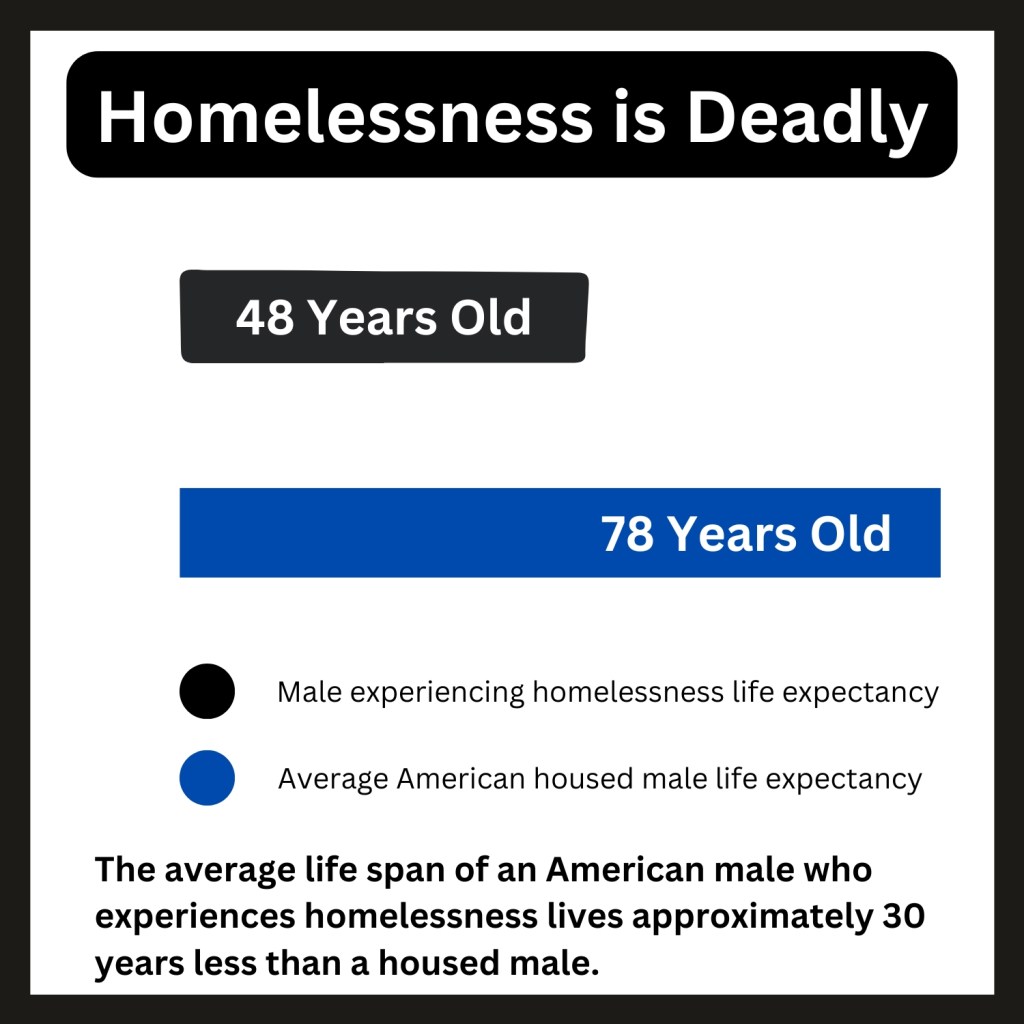
Three alarming facts about the high cost of homelessness have been discussed recently in a local McMinnville group of homeless service providers and volunteers. Number one: the homeless live about 30 years less than Americans who live in a home. Number two: It cost the taxpayers less to place a homeless person into permanent housing than to keep a person in the Warren County jail for a year. Number three: The homeless are a portion of the self-pay patients who are uninsured or underinsured, costing Ascension Saint Thomas River Park Hospital several million dollars a year in charitable health care.
Dale Humphrey, President and CEO of Saint Thomas River Park Hospital, informed the group earlier this month that homeless men die about 30 years earlier than their peers who live in a home. Clearly, anyone who lives on the street, under a bridge or in a tent for an extended period of time pays the highest price of homelessness. Being homeless without proper housing is not healthy. While the homeless’ illnesses may not be much different than the non-homeless population, the homeless illnesses are usually much more severe and typically managed worse due to difficulty in cleanliness, nutrition, access to follow up care, and access to proper medication. Humphrey stated that stress is obviously a contributing factor.
Dale Humphrey also informed the group that the hospital has $7 million in charitable health care per month, and a significant portion of that charitable health care is contributed to the McMinnville homeless population.
Left to right, President and CEO, Dale Humphrey and Sheriff Jackie Matheny, Jr.
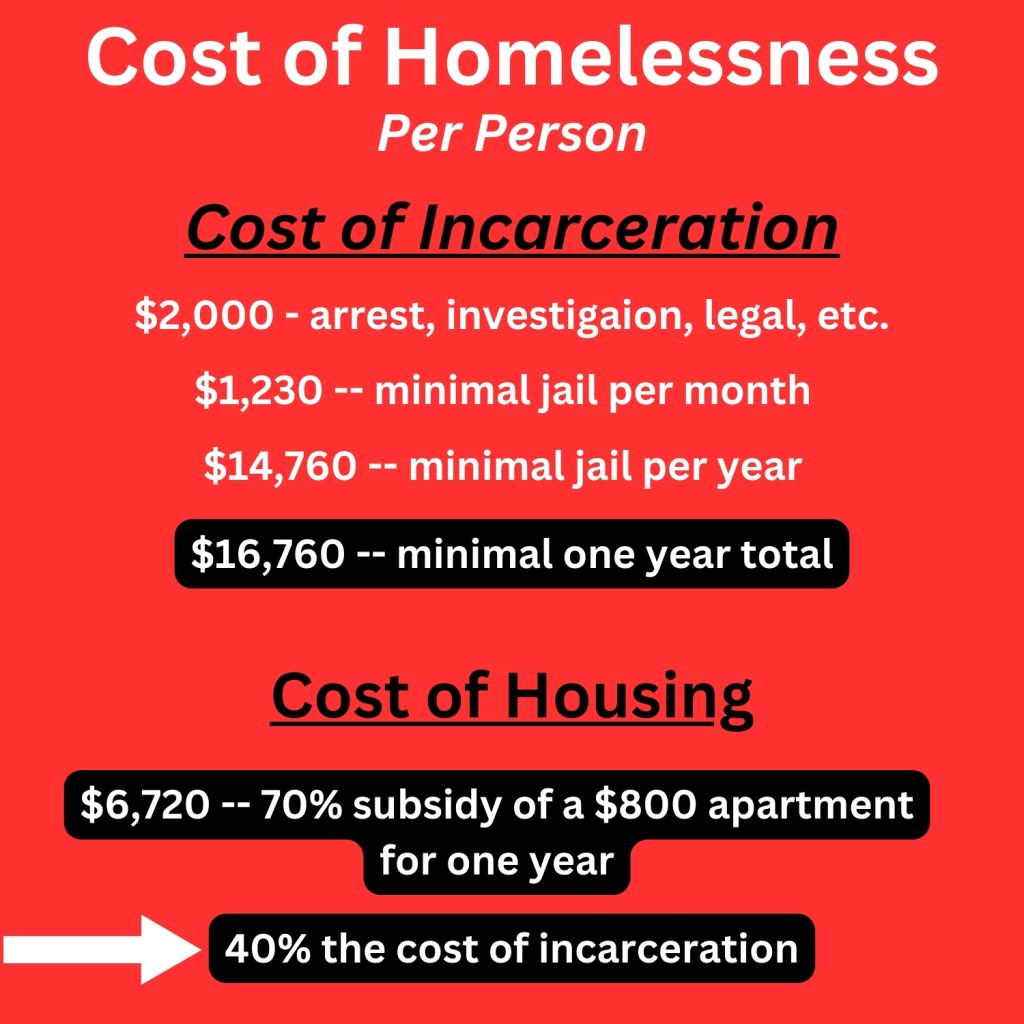
During the February meeting, Sheriff Jackie Matheny, Jr. spoke to the group and stated that at least 12 of the 258 inmates in the Warren County Jail were homeless. Sheriff Matheny also confirmed that the minimal cost to the taxpayers to keep someone in the local jail is $41 dollars a day. Taxpayers pay more to keep someone in the Warren County jail than taxpayers pay to keep someone in subsidized, affordable housing. See the image below for a detailed illustration.
* The cost of arrest, investigation and legal fees are estimated.
A local nonprofit or city/county government can apply for HUD funding to provide permanent supportive housing for the homeless. HUD offers rental assistance that pays 70% of the rent on privately-owned apartments. The subsidy for an $800 apartment would be $560 a month. That is $18.60 per day, which is 45% of the cost to keep someone in the Warren County jail.
Common themes from both Sheriff Jackie Matheny. Jr. and Dale Humphrey were the high rates of recidivism and recycling of the same homeless population through the jail and hospital. Placing people who are experiencing homelessness into permanent supportive housing can extend lives — in addition to saving taxpayers and the local hospital a lot of money. All of this begs the question of how to develop a cost-effective solution to homelessness in McMinnville.
BEYOND THE BRIDGE: A POSITIVE SOLUTION TO HOMELESSNESS PROMO
Readers of this newsletter are encouraged to see the film, Beyond The Bridge. The film is a documentary about solutions to homelessness. The filmmakers traveled over 40,000 miles and studied positive solutions to homelessness. The film highlights solutions in two cities. Beyond The Bridge is showing at Otter Creek Church on West End in Nashville at 6:00 PM on Thursday, April 3. Tickets are free and must be reserved online. This is a link to information about the film and tickets:https://asolutiontohomelessness.com
Full disclosure, I have been promoting a plan to create affordable housing for 10 homeless people in McMinnville. I am personally looking forward to learning more about positive solutions to homelessness from Beyond the Bridge and the discussion after the film. Nashville Mayor Freddie O’Connell and the filmmakers will be at the event.
For more information, please attend the monthly homeless meetings in McMinnville. The next meeting will be Friday, April 25, at 11:00 AM, at St. Matthews Episcopal Church.
When I grew up in McMinnville many decades ago, there were no “immigrants” that I was aware of in my hometown. As I grew older, I eventually came to the conclusion that almost all of us are “immigrants.” It has become a hot topic recently. Some polls had immigration as a top five issue in last year’s 2024 presidential election.
Personally, I did not become aware of any new immigrants in McMinnville until the 1980s. There were not any Hispanics living in McMinnville that I was aware of when I grew up here. The last US Census states that 10.1% of the Warren County population is Hispanic or Latino. Link:https://www.census.gov/quickfacts/fact/table/warrencountytennessee/PST045224
The population has changed over the decades, and I believe that that is a good change. I am very grateful for the vibrant and hard-working Hispanic community in McMinnville. There is one family in particular that has enriched my life tremendously with their friendship and fellowship.
The campaign and recent rhetoric about immigrants and deportation by President Trump concerns me. The executive order which attempts to end automatic citizenship for babies born on American soil actually shocked me.
That executive order was blocked and reported by the New York Times on Thursday, January 23: In a hearing held three days after Mr. Trump issued his executive order, a Federal District Court judge, John C. Coughenour, sided with Washington, Arizona, Illinois and Oregon, the four states that sued, signing a restraining order that blocks Mr. Trump’s executive order for 14 days, renewable upon expiration. “This is a blatantly unconstitutional order,” he said.
To better understand these issues, I asked McMinnville’s immigration expert, Attorney Kara Youngblood, five questions via email. The following are those questions and answers.
BD Newsletter: Please share your perspective on what is happening with federal immigration policies, and do you have a prediction on what the outcome will ultimately be regarding the birthright to citizenship issue?
Kara Youngblood: The implementation of the new immigration policies will likely result in extended processing times, heightened scrutiny of immigration applications, increased discretion granted to immigration officers and prosecutors, as well as a backlog of cases within immigration courts. It is particularly noteworthy that a federal judge appointed by President Reagan issued the injunction. Given the recent rulings by the Supreme Court, it is reasonable to anticipate that the executive order will ultimately be invalidated, even by the most conservative of courts.
BD Newsletter: Do you foresee any differences between the federal policies/laws and state and local policies/laws? In other words, will federal policies override all local and state policies?
Kara Youngblood: With the recent passage of the state bill that felonizes any vote of an elected official against federal immigration policy it seems like federal may win out. However, it should be noted that both the recent executive orders and this aforementioned state bill are likely unconstitutional and will most likely be immediately challenged.
Under federal preemption law, federal law generally takes precedence over state law if they conflict.
BD Newsletter: How active is ICE (U.S. Immigration and Customs Enforcement) in McMinnville and Warren County? Does this federal law enforcement agency have an office here?
Kara Youngblood: At present, ICE does not maintain an office in McMinnville or Warren County; however, it is anticipated that their presence will increase in the near future, particularly in light of Governor Lee’s initiative to establish a Centralized Immigration Enforcement Division (CIEO). Gov. Lee’s agenda also aims to incentivize local governments to collaborate in the enforcement of federal immigration policies and allocate funding to support both federal and state immigration efforts. Additionally, we can expect an expansion of ICE activities, particularly as ‘sensitive’ areas, such as schools and places of worship, are no longer protected under the same restrictions. Since 2011, such locations were considered ‘sensitive’ and were off-limits to ICE raids except under specific, limited circumstances; however, under the previous Trump administration, these areas were no longer classified as ‘sensitive’ and thus are now subject to enforcement actions.
BD Newsletter: What would you advise an immigrant who is not a U.S. citizen and living in McMinnville to do, in addition to contacting your office for legal consultation?
Kara Youngblood: Know your rights and if you are here lawfully, be sure you keep proof of that with you. We have created a “Know Your Rights” campaign on the Youngblood & Associates social media platforms that will be published over the next few weeks. Keep an eye out for those.
BD Newsletter: What percentage of your clients live in McMinnville and Warren County?
Kara Youngblood: I cannot answer this question. I believe Tenn. Sup. Ct. R. 8, RPC 1.6 would apply in this instance which prohibits me from sharing client information individually or collectively without their consent.
Bonus Question:What motivated you to practice immigration law?
Kara Youngblood: My father has owned and operated a nursery in Morrison my whole life. The immigrant population is an integral part of the agricultural industry. I was exposed to the immigration system from a young age, seeing the vast expanse of how immigration shaped the lives of those that worked side by side with my father, and who ultimately became like a part of our family. From the positive impacts of the green card and naturalization processes to negative consequences of immigration detentions and deportations, I was privy to a world that most US citizens never see. I found the complexity of this facet of the law interesting and knew the positive impact I could have for many people if I studied it and offered solutions to the many qualified individuals that simply needed someone on their side to navigate the complex system for them.
I always say that unlike many other types of law, no one loses when I win a case. Most of my clients have already positively integrated into our community, but my services allow them to finally do so out of the shadows and with the peace of mind that every person deserves.
Attorney Kara Youngblood in her office.
BD Newsletter Footnote:The following is a brief overview of Kara Youngblood’s professional career.
Kara Youngblood is the founding attorney of Youngblood & Associates, which is dedicated to providing legal immigration services to individuals and families and labor solutions for green industry employers. Website: www.youngbloodassociates.com
Youngblood is also the owner of The Local on Morford restaurant, which is part of the major renovation projects she has undertaken on Morford Street. Kara Youngblood was elected to office as a City Alderman in 2024 and is chairman of the Building & Grounds committee. She also serves on the Tourism & Marketing, Parks & Recreation, and Water & Wastewater committees.
Youngblood was Valedictorian of her Warren County High School senior class, Middle Tennessee State University, Bachelor of Science, and The University of Memphis—Cecil C. Humphreys School of Law, Juris Doctor, Law.
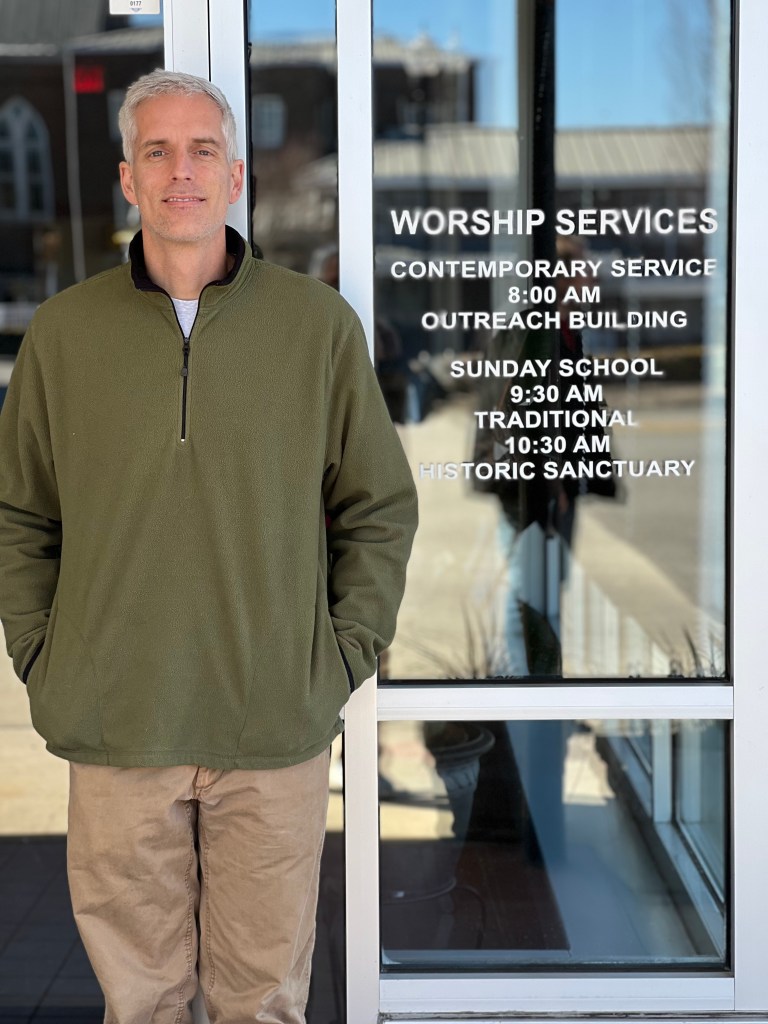
Ryan Heatherly, Senior Pastor at First United Methodist Church
By BRAD DURHAM
One of the most historic churches and buildings in downtown McMinnville over the past 135 years that continues to serve the community is First United Methodist Church. Ryan Heatherly is in his fourth year as the Senior Pastor for First Methodist. He is an intelligent, well-spoken man who has a heart for ministering to the poor in McMinnville. Ryan has taken an active role in leading the volunteer-operated Cold Weather Shelter at the First United Methodist Outreach Building which is located in the old H.G. Hill grocery store building next to the Church.
Recently, I asked Ryan Heatherly to answer five questions, and the following are Ryan’s answers to those questions.
BD Newsletter:Can you give me a brief biography — for those who do not know you?
Ryan Heatherly: I have been a pastor since 2014. Grew up in Union City in West Tennessee. My dad was a teacher. I was always going to be in the public education system. I went to UT in Knoxville, and since my dad was an employee of the state of Tennessee, I received a 25% discount on tuition.
Since I didn’t know what I wanted to do, one day my dad said, “What about business?” And I said, “Okay.” That sounded reasonable enough, and I got a marketing degree. After graduation, I went into sales. I did professional sales for about eight years. My last two stints in sales were during 2008-2010. The economy was not doing well and was in the tank. In 2008, I was laid off with about 10,000 people in the company. I was doing logistics sales.
During this time, I made a connection as I was finishing a graduate degree at UT, so I went into medical sales. But that didn’t go well either. I was terminated for not hitting my number.
Through a series of interviews that followed after that and some assessments I had to do to try and get my next job, I felt a call to the ministry. That decision was validated by some interesting, unforeseen spiritual encounters and experiences. Long story short, I went into ministry as an underpaid and overworked youth director at a small church.
In that I found my calling…something that others saw in me that I did not see in myself. I feel like I found a purpose in my life that was missing running in the rat race of life, trying to chase a number.
I grew up in a small, rural United Methodist Church, which is why I am in the United Methodist Church. It is native to my experience and my Christian faith. I grew up in a youth group, and at various times, my parents were youth leaders. I got real involved in the church as a young person, especially in high school.
My hobbies include playing golf and basketball. I played a lot more golf in my childhood. Through golf on the high school golf team, I got involved in the Fellowship of Christian Athletes. Faith and sports have always been interesting to me. At various stops in my ministry, I have tried to incorporate those two things. I eventually laid down my golf clubs. My son is 11, and I spend a lot of time in the gym with him coaching his team and playing basketball. I would like to see the resurgence of a church league here in town.
I am married, and we have been married since 2010. We have one son. For about three years we were foster parents. There is a 21-year-old young man out there somewhere who means something to us. He reminds me a lot of the cases that I try to minister to today…that rings true.
BD NEWSLETTER: What is your vision for the Emergency Cold Shelter for men at FUMC?
Ryan Heatherly: I would say that is still in formation…part of my vision is owed to my experience when I was serving at Grace United Methodist Church in Mt. Juliet. We were one of the suburban churches helping at Nashville’s Room In The Inn. Room In The Inn is an ecumenical effort to house people during the cold weather months. As a volunteer and pastor on staff, I was one of the volunteers who would stay overnight with the homeless guests. We partnered with a Catholic Church in town a couple of miles away. They had the space, and I volunteered there.
My vision is rooted in that experience in which a lot of churches can work together. Volunteers can make sure that people do not freeze to death during the coldest months. I think the role I am in now is more challenging because it is more organizational. I am trying to help lead our church and others in the community to share in this ecumenical effort. I have seen this work in Nashville and suburban areas.
I think it has the potential to work well here in McMinnville, and we are planting seeds for cooperation among churches. There is one Gospel. There is one Lord. The message that is inescapable is Jesus Himself was a person who bounced around from place to place. He ministered to the impoverished, the unfortunate, those on the margins.
If we are going to believe Christ, if we believe His words and witness, I think some ministry to serve those who are less fortunate and to help them on their journey as their friend has to be part of our ministry. I think our campus at First United Methodist Church is extremely versatile. We have three different buildings.
When I came to McMinnville, I learned that we had an outreach building. One of my predecessors, Adam Rush, was instrumental in getting some of the ministries going with the homeless. There were showers and other resources for people in the outreach building, and I think he helped support those efforts.
For us to have an Outreach Building, I think it would be a shame to call it that and not live up to its name. If we are going to have an Outreach Building, it is imperative that we reach out to those in the community. Some of those in our community walk by our church several times a day. Some are homeless. Some are struggling with addiction. Some need mentors. Some have skills that can be used in the life of the church that are often overlooked.
I would like to see how we can leverage those skills among the people that we serve. Maybe they can be of help to the needs of the church and community. They could be put in places where they would be valued and relied upon. A small example of that is the rodent problem we have in the basement of the Outreach Center. A homeless guest helped me make a mouse trap, and I am going to put that in the basement and see if it works. I brought the tools and he did the labor, and together we did it. FYI – We just caught our first mouse!
I would like to figure out how we can help support people to move ahead in life. I don’t think many people say when they are growing up that they want to be homeless. I have never heard anyone seriously say that or sarcastically say that. Yet, that is where they find themselves. Some people are ready to work and walk through that process, and others may not be. I think it is important to be willing to work with anyone to see who is the most ready to benefit some guidance, support and nurturing. In some cases, they may need to be challenged to utilize their gifts and capabilities.
In summary, my experience at the Room In The Inn, the reality that we have an Outreach Building at First United Methodist Church, and the general life and witness of Jesus.
BD Newsletter: What part of the Gospels, teachings of Jesus inspired your vision?
Ryan Heatherly: Beginning with the Scriptures, I also think there is an experiential component to it as well…If I think about the early life of Jesus from his earliest days, his family was on the run. They were refugees in Egypt for some length of time. They settled in Nazereth, and as an older person, Jesus made Capernaum his hometown. He probably stayed with Peter’s mother-in-law a lot of the time.
Jesus himself said, “The Son of Man has nowhere to lay his head…” This was something that he was probably accustomed to, maybe comfortable with – not having a home. Jesus had a purpose, but he appeared to be comfortable with being homeless. That was part of his greater purpose. He was not settling down; he was always on the move. He had a nomadic lifestyle. I think He used that to do the greater good, to serve his ultimate calling — to save the lost.
There is an inescapable scripture that is well-known and cited often — Matthew 25:31-46. I just recently preached on this and used it as a platform to talk to our congregation to use our Outreach Building as a Cold Weather Shelter. I acknowledge the fact that we often do not know what is helpful and what is hurtful for underprivileged people or someone who lacks housing.
Jesus said, “Whatever you did to the least of these, you did to me.” On the flipside, whatever you don’t do for the least of these, you don’t do for Me. I think that is an inescapable challenge for those of us who take Jesus’ words seriously.
In that passage, He introduces the idea that it is a judgment of nations, which we sometimes overlook. I think that as one of the most privileged nations, we need to take seriously the call to think about those who are less fortunate. While we may be a rich nation in comparison to other nations in the world, I think it is our duty and responsibility to minister to those who don’t share in that prosperity.
At the conclusion of His teaching, Jesus said in Matthew 25:45, “In truth I tell you, in so far as you neglected to do this to one of the least of these, you neglected to do it to me.” When we leave somebody else out, Jesus would say that when we are overlooking Him, leaving Him out…we are leaving Him out of the equation of our life and our calling.
BD Newsletter: Do you have a strategic plan for the shelter and people experiencing homelessness in McMinnville?
Ryan Heatherly: I think our strategic plan is unfolding, coming to the surface. We may not have a strategic plan written down, but I also recognize that we could talk about things for a really long time and not act upon them. We are learning a lot. I am proud that we actually doing something as a church and community with the space and resources that we have.
We have plenty of resources in terms of financial contributions and human capital to do something that is worthwhile. Initially when I made the appeal to the congregation to go forth with this Cold Weather Shelter…I felt as though it was a need. We have the resources. We also had some experience with it on a short-term basis last year. We are now at a point to make a go at it, and along the way, we can do it increasingly well.
It hasn’t been perfect. My vision is to get as many churches involved as possible. Because of my experience with Room at the Inn, I do not think one church can solve the homeless challenge or epidemic. It is going to take more than me. It is going to take more than one church. If we are all ministering to the same community, it makes sense to me to join hands – to try and offer the resources and gifts that each church and civic organization can contribute.
One of the things we can offer as a church is space with the Outreach Center. We can live up to our name as an Outreach Center. That is what we are doing.
I hope that I have a much more concrete answer to that question a year from now.
BD NEWSLETTER: What do you like best about living in McMinnville?
Ryan Heatherly: I really like the outdoor scene here, the Barren Fork River. One of the baptisms we had was in Myers Cove, and I like the natural scenery. The proximity to the big city life is available if you want it. I grew up in a small town, I prefer living in a smaller town. McMinnville reminds me of the small-town environment that I prefer. Having lived in suburban Nashville, I cannot see myself living in a big city and enjoying it as much.
I also like that my family likes McMinnville a lot. There has never been a day when my wife or son have said they are looking forward to the next place we will live. It is more like I dread the day we have to leave. We have moved a lot. Hopefully, we won’t have to think about that for a long time.
This morning I was reading a post on Facebook with random facts. One of the facts stated that outdoor cats live for 3 years and indoor cats can live up to 16 years. The next thing I did was google it, and this came up in my search:
“An indoor cat may live 15-17 years, while the life expectancy for outdoor cats is only 2-5 years, according to researchers at University of California-Davis. Dr. Jeff Levy, DVM, CVA, owner of House Call Vet NYC, also discourages owners from keeping cats outdoors.”
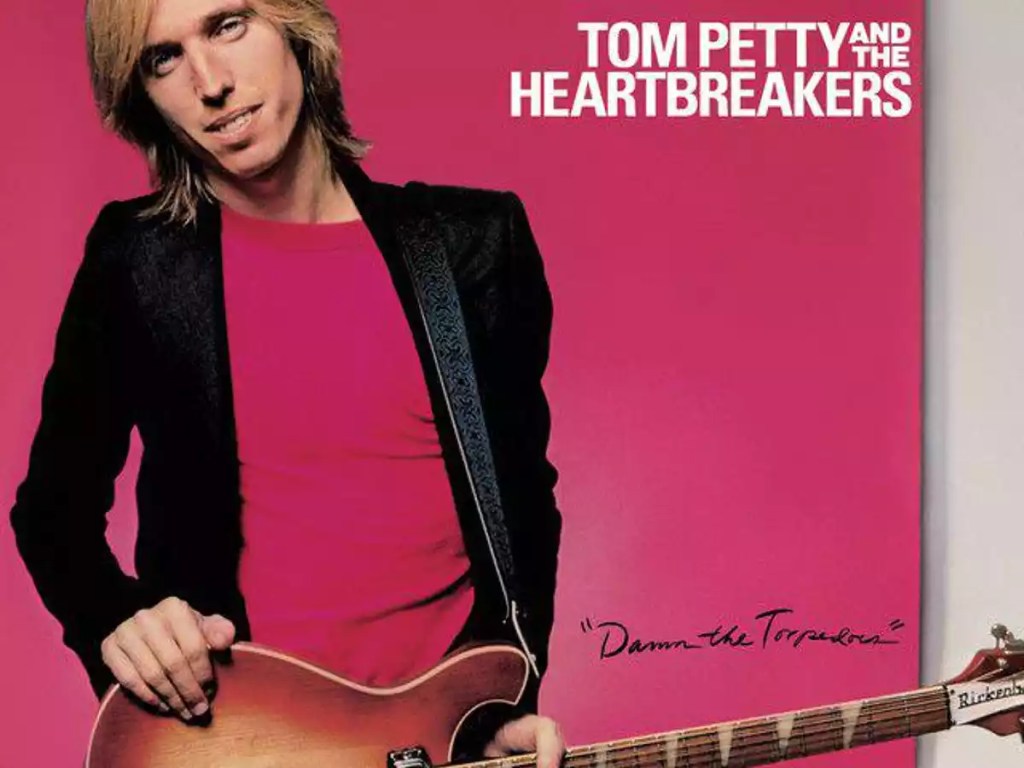
As I contemplated this, I visualized a cat I often see who lives outside. Then I started thinking about people living on the street and in tents in McMinnville. My mind also drifted to people who live outside in tents in refugee camps. Then Tom Petty’s song, “Refugee” popped into my head.
REFUGEE, BY TOM PETTY
We did somethin’ we both know it We don’t talk too much about it Ain’t no real big secret all the same Somehow we get around it Listen it don’t really matter to me, baby You believe what you want to believe You see, you don’t have to live like a refugee (don’t have to live like a refugee)
Somewhere, somehow, somebody Must have kicked you around some Tell me why you want to lay there Revel in your abandon Honey, it don’t make no difference to me, baby Everybody’s had to fight to be free You see, you don’t have to live like a refugee (don’t have to live like a refugee) Now baby, you don’t have to live like a refugee (don’t have to live like a refugee) No
Baby we ain’t the first I’m sure a lot of other lovers been burned Right now this seems real to you But it’s one of those things You gotta feel to be true
Somewhere, somehow, somebody Must have kicked you around some Who knows, maybe you were kidnapped Tied up, taken away and held for ransom, honey It don’t really matter to me, baby Everybody’s had to fight to be free You see, you don’t have to live like a refugee (don’t have to live like a refugee) No, you don’t have to live like a refugee (don’t have to live like a refugee) You don’t have to live like a refugee (don’t have to live like a refugee) Oh, oh, oh
Songwriters: Michael W Campbell / Thomas Earl Petty
Tom Petty may have been singing about lovers, but it fits perfectly as I think about people who are experiencing homelessness. However, there is a catch for me personally. During the past year, I have been volunteering to help a little with people who are homeless. I am watching people leave a building after they can eat and shower to go live outside and sleep outdoors on the actual streets, sidewalks and in tents. I have come to the conclusion that I am enabling or helping them to live there by not doing something to help them live in a home.
So, I googled “life expectancy of a person living outdoors vs. indoors.” This is what appeared on my computer screen:
Generally, a person living primarily outdoors would have a significantly lower life expectancy compared to someone living indoors, due to increased exposure to environmental hazards like weather extremes, predators, accidents, and lack of access to basic necessities, making living entirely outdoors is considerably more risky for health and longevity.
Key points to consider:
Environmental dangers:
Exposure to harsh weather conditions, including extreme heat, cold, rain, and storms, can lead to health complications and potential fatalities.
Predators and accidents:
Individuals living outdoors are more vulnerable to attacks from wild animals and potential accidents due to lack of controlled environments.
Access to healthcare:
Limited access to medical care and sanitation facilities when living outdoors can exacerbate health issues.
I don’t need medical experts to tell me that living outdoors shortens the life expectancy of someone. I have seen what happens with my own eyes. People’s health deteriorates rapidly over a few months of living outdoors or in conditions where the roof leaks and there is no electricity or running water. The hazards of living outdoors, especially when you are disabled are real. Thurman Crisp, a disabled veteran, was living on the streets in McMinnville, and he passed away on December 2, 2024 when he was crossing the street and hit accidentally by a vehicle.
Tom Petty was right, you don’t have to live like a refugee. But until I can help develop and implement a strategic plan to keep men and women from living outside in tents and living in a home, I believe that I am allowing people to live like refugees in McMinnville. And I am embarrassed to keep thinking and saying that there is nothing I can do about it.
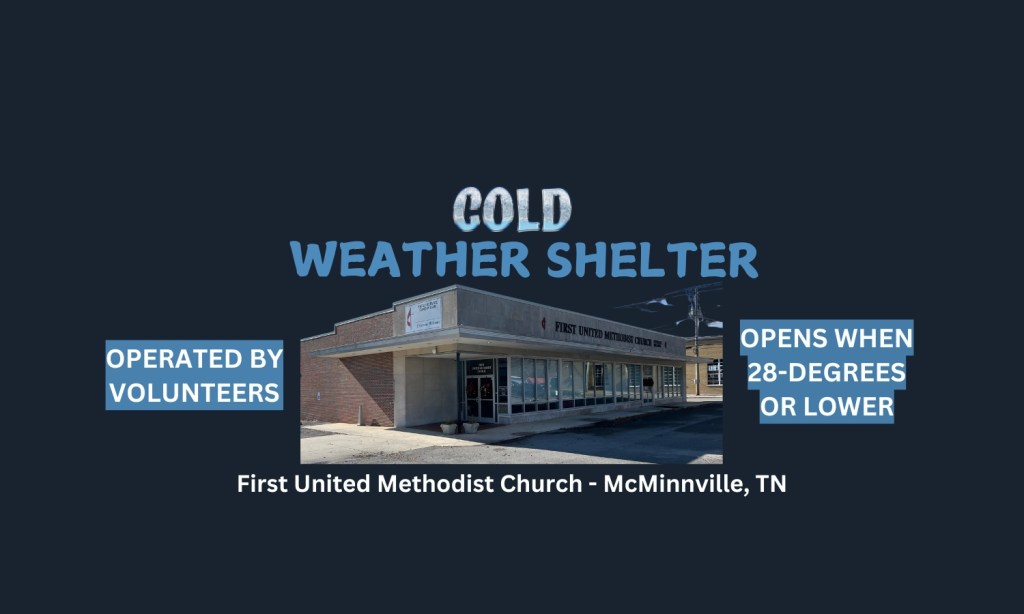
First United Methodist Church, St. Matthew’s Episcopal Church and H.O.M.E. are collaborating to provide a men’s shelter during cold weather at First Methodist’s Outreach Building. The staff is maintained by volunteers, and volunteers are needed to stay overnight with the guests. A signup link is below.
Registering at the link above with SignUpGenius will take only 5-10 minutes.
If you wish to speak with anyone about volunteering, please call First United Methodist Church at (931) 473-4419.
Volunteers will be asked to sign a code of conduct form and stay at the shelter from 8:30 PM to 7:30 AM.
GENERAL INFORMATION
The McMinnville Cold Weather Shelter for men will open on a contingency basis – based upon two factors. When the temperature is 28-degrees or below (or 25-degree wind chill factor), the Cold Weather Shelter will open. The other factor will be if there are a sufficient number of volunteers to operate the overnight shelter.
McMinnville First United Methodist Church is hosting the McMinnville Cold Weather Shelter for men only from 6:00 PM to 7:30 AM. This is a collaboration with St. Matthew’s Episcopal Church, HOME and volunteers.
Please spread the word so that any male person experiencing homelessness in McMinnville and Warren County will have the opportunity to come inside during severe cold weather.
If you or anyone you know wishes to volunteer, please have them contact First United Methodist Church at (931) 473-4419.
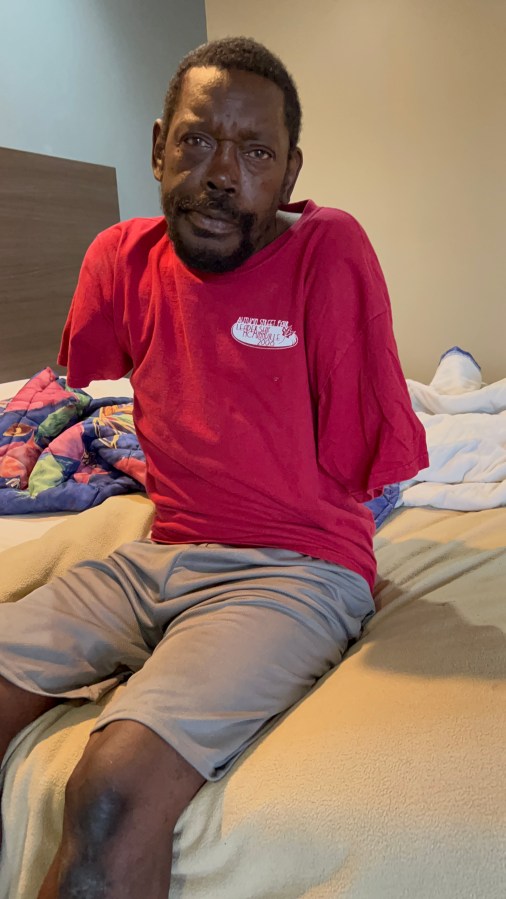
I have known James Albert since January. We met at the outreach breakfast at First United Methodist Church’s Auxiliary Building. James Albert peaked my interest because he could eat and do so many things — with no arms. When I saw him early last week on the street, I was shocked to learn that he had become homeless. Immediately, I knew that I had to try and help him.
A SEVERE DISABILITY
It is not easy doing all the things you have to do to survive and thrive when one is homeless. If you are homeless and have no arms, taking care of yourself becomes more challenging. James lost his arms in a tragic accident working on electrical lines 10 years ago in Murfreesboro. The settlement money no longer exists. The reality is that he cannot work and needs rental assistance, as well as supportive services.
James can make calls on his phone, which was broken. We are in the process of getting James a new phone. He can prepare a lot of his own meals, change his own clothes, take a bath — by himself.
A TEAM OF SUPPORT
I contacted Sheila Fann at HOME, and she said HOME would help pay for a hotel room for a few nights. I immediately began trying to learn the details of why James is homeless. I asked James to sign a Release of Information form (which he did by writing with a pen in his mouth). HOME has been helpful. Ryan Heatherly, the Senior Pastor at First United Methodist Church has been helpful. Jimmy Haley has been helpful during the Saturday morning outreach and in many other ways. Several people have donated money to help James Albert, and I am very grateful for each gift.
AN APPEAL FOR DONATIONS
I am making another appeal for donations. The link will work this time, and I am asking everyone to share the link with people they know. If 400 people donate $25, we will reach our goal of $10,000.
First and foremost, money will be spent to provide safe housing for James until permanent housing is secured. Efforts are being made to get James into housing other than a hotel, which is burning cash. There is no emergency housing for homeless men in McMinnville. That is something that will hopefully change in the future, but right now, I am an advocate for James and asking for help — to keep him safe.
The second emergency expense is food. A lot of meals can be donated, but that requires coordinated volunteer help. Connecting James to free meals and food is part of the present effort to help him. Unfortunately, there are times where James needs meals — the morning, certain evenings, especially on the weekends.
There are other everyday items James needs such as body wash, detergent, laundry mat services, etc. Some of these things can be donated, and sometimes they are not readily available. James also needs help paying for the UCHRA bus. Everything is being done to stretch every dollar, and what is not spent on emergency expenses will go toward providing items for permanent housing.
James receives disability from Social Security and some food assistance through his insurance. One of the reasons James is homeless is because there was a disagreement over handling his money with his helper, whom he lived with for 10 years. I am not sure of all the details, and that is water over the dam. Steps are being taken to ensure that James will personally manage all of his money in the future. Last week he set up his own bank account to make that happen.
OTHER WAYS TO HELP
LANDLORDS. Once James has a rental voucher, his rent will be guaranteed. A landlord will not have to worry about nonpayment. And James will have a team of supportive services helping him.
PERSONAL NAVIGATORS-ASSISTANTS. James needs personal navigators/assistants who can help direct him to various places such as free meals, where to get his clothes washed, help with cleaning his living space, preparing meds, etc. Someone needs to check with James each day presently and in the future. This volunteer position will often require running errands and sometimes taking James where he needs to go.
THE PARABLE OF THE GOOD SAMARITAN
A couple of weeks ago, before James was homeless, someone reminded me of the Good Samaritan parable. Someone asked Jesus who is my neighbor? Jesus replied by telling the story of a man who was beaten and robbed by bandits, and was left half dead. A priest was traveling and saw the beaten man, but walked by him on the other side of the road.
In similar fashion, a Levite saw the wounded man, but also passed him by. Then a Samaritan traveler came to the location and saw the man. He bandaged the man’s wounds and took him to an Inn. He paid the innkeeper and asked him to take care of the man. The Samaritan also promised to pay any extra expenses for the man on his way back.
Jesus asked, “Which of these three do you think proved himself to be a neighbor to the man who fell into the hands of the bandits?” The answer was the man who showed pity towards him. Jesus said, “Go and do the same yourself.”
CALL TO ACTION
If for any reason you are compelled to help James, please do one of three things.
1. Click on the link above and make a donation.
2. Seek out landlords who may provide a permanent place for James to live.
3. Become a personal Navigator/Assistant one day a week for James.
4. Please share this appeal to help support James with 5-10 friends.
Call or email me if you wish to help with housing or personally assisting James Albert.
Cell: (615) 838-4426 Email: brad412@benlomand.net
If you wish to mail a check or give cash instead of donating on the above link, please make checks payable to:
First United Methodist Church c/o James Albert Fund 200 West Main Street McMinnville, TN 37110
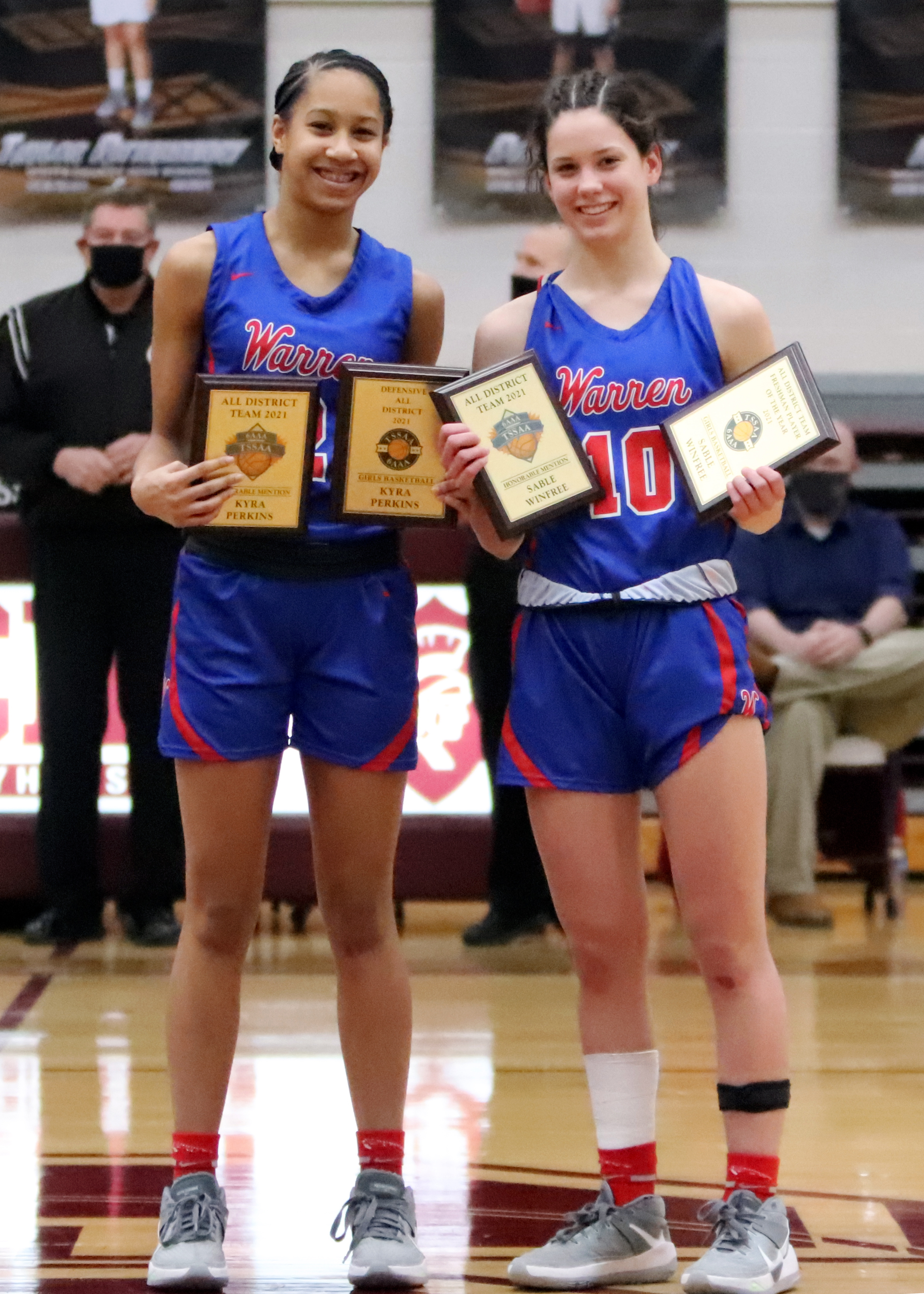
Attorney Michael D. Galligan has filed a lawsuit on behalf of Sable Winfree, a senior student at Warren County High School. The suit is against the Warren County Schools District, Mendy Stotts, Chris Hobbs and Dr. Grant Swallows. The lawsuit was filed in the United States District Court, Eastern District of Tennessee at Winchester on Thursday, April 18, 2024.
The lawsuit requests a judgement against the defendants Warren County School District, Mendy Stotts, Chris Hobbs and Dr. Grant Swallows in a sum not to exceed $750,000. The lawsuit is in federal court and requests a trial by jury.
The facts of the suit state that Sable Winfree was denied her rights under the Fifth and Fourteenth Amendments of the United States Constitution. Specifically, the Fifth Amendment protects against the taking of property by the government without compensation. The lawsuit claims that the defendants took Winfree’s rights to a basketball scholarship and future education.
The argument for the application of the Fourteenth Amendment indicates that as a citizen of the United States, Winfree was denied her property without due process of law. Moreover, the suit claims that Winfree’s facts were not allowed to be heard.
The facts of the lawsuit focus on the dismissal of Sable Winfree from the high school Lady Pioneer basketball team. Winfree had been Freshman of the Year and All-District her sophomore and junior years. The heart of the legal case is an accusation by Mendy Stotts, then the head girls basketball coach, claiming that Sable Winfree used the f-word in conversation with the coach during practice on November 15, 2023. Winfree denies this is true and states that she has witnesses of the fact.
Before Winfree was dismissed from the team, she had been offered a full scholarship to Trevecca Nazarene University. Two weeks after Winfree was dismissed from the team, the coaching staff of Trevecca contacted Winfree and informed her that the scholarship was being rescinded.
Other damages delineated in the lawsuit claim that Winfree has suffered more than the loss of a scholarship and potential future scholarship offers. The suit states that Stotts’ false statements also led to harm of Winfree’s reputation in the community, as well as subsequent embarrassment and humiliation.
Not mentioned in the lawsuit but relevant to people of faith and germane to Stotts’ accusations against Sable Winfree is the Ninth Commandment. “You shall not give false evidence against your neighbor.” (Exodus 20:16, The New Jerusalem Bible.)
After filing the lawsuit and the defendants were notified that a lawsuit had been filed against them, Michael Galligan made a statement. Galligan said, “I wish the goal was to put the student’s rights and well-being over all other considerations.”
Dr. Grant Swallows, Chris Hobbs and Mendy Stotts were contacted for comments regarding the lawsuit. Dr. Grant Swallows stated via email: “Warren County Schools received the information regarding a lawsuit. We have not had the time to review as of yet and furthermore our policy prevents us from commenting about pending litigation.”
Attorney Michael D. Galligan reviewing the lawsuit he filed on behalf of Sable Winfree in his offices. Ironically, Galligan previously served as the Warren County Schools attorney several years ago.
For a list of who attended the meeting, go to the end of this letter.
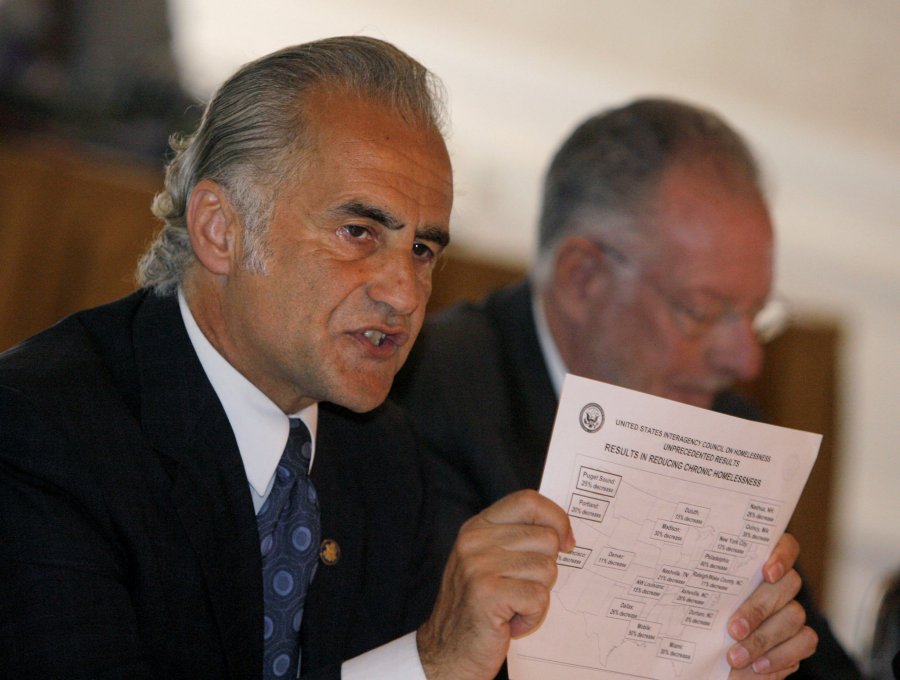
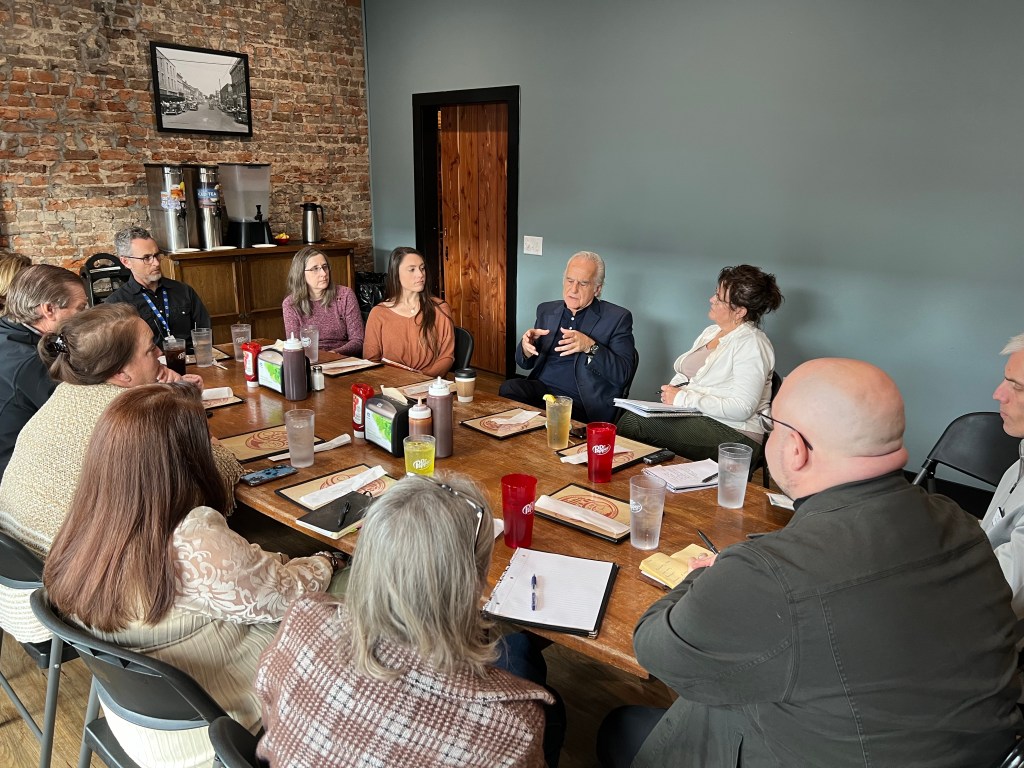
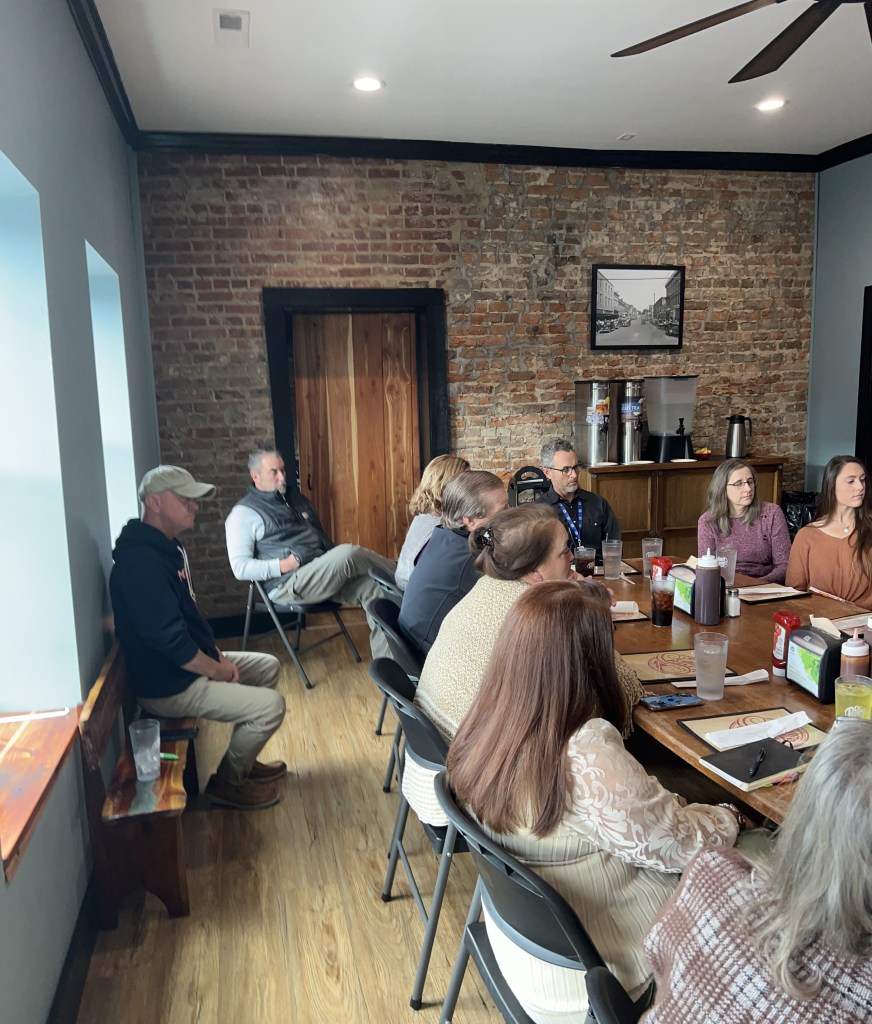
On Friday morning, January 26, a group of 14 McMinnvillians gathered for a presentation by Philip F. Mangano. Mr. Mangano served as President George W. Bush’s Executive Director of the White House’s U.S. Interagency Council on Homelessness. Brad Durham, who worked with Mr. Mangano in Cambridge, Massachusetts placing homeless families into permanent housing, invited Mangano to McMinnville.
HOUSING FIRST SOLUTION
The heart of Mangano’s presentation was housing first, a concept to end homelessness, not to provide endless services. Mangano stressed that data clearly supports the housing first policy.
COST-EFFECTIVE SOLUTION FOR CITIES
It is cost-effective to place a homeless person or family in permanent housing versus a shelter or transitional housing. Mangano said, “Mayors know the cost involved related to caring for a homeless person. A homeless person incurs expenses that a community pays for such as health care, mental health, police, court costs, addiction, etc.” Mangano stated that a city spends between $25,000 to $138,000 a year in services for a homeless person.
STABLIZES A HOMELESS PERSON
A permanent home is the most cost-effective solution to homelessness because it stabilizes the homeless person. When a homeless person is safe and secure in a home, the health care, mental care, and other services are more easily identified and effective. The services follow the homeless person into a home.
WHAT EVERY HOMELESS PERSON WANTS
Mangano emphasized that there is one thing every homeless person says that he or she wants — when asked — is a place to live, a home. Although the housing first solution appears to be self-evident, Mangano stated that homeless advocates often act out of genuine compassion by providing transitional housing and services that create a perpetual cycle of services that sadly do not end homelessness.
Another major desire homeless people ask for is a job. Mangano said, “Homelessness results in an unraveling of social capital – the loss of friends and family.” Clearly, when an individual or family is homeless, that person or family have busted through every possible safety net and hit the street. A homeless person is completely alone…lonely. A homeless person intuitively knows that a job will provide friends — the social capital everyone needs.
Philip Mangano suggested a book by Robert Putnam to better understand how the social fabric has diminished in America’s recent history. That book is Robert Putnam’sBOWLING ALONE: The Collapse and Revival of American Community. The book was developed from Putnam’s essay entitled, “Bowling Alone: America’s Declining Social Capital.”
A COMMON FRUSTRATION AND PERCEPTION
Several members of Friday’s gathering stated that there is no affordable housing in McMinnville. Mangano replied, “Homeless advocates in every city say that. That is a common perception. The response requires innovative thinking and a commitment to housing first principles.”
THREE BOOK RECOMMENDATIONS
Philip Mangano worked with three researchers and authors who have worked with executives in the corporate world to find solutions to business problems. These authors helped research and provide the framework for successful housing first models and policies.
Using Gladwell’s book and homeless research as a resource, Mangano said, “Investing resources into the most challenging and difficult parts of homelessness from an economic perspective leads to a decline in homelessness.” Conversely, providing compassionate emergency services without a housing first policy does not effectively create a decline in homelessness.
Mangano’s alluded to examples of creative solutions involving converting motels into housing that have services onsite. He also mentioned manufactured housing as a cost-effective solution for a homeless person or family.
Clayton Christensen’s book, THE INNOVATORS DILEMMA offered examples of how businesses seeking to move to the next step often failed when using the solutions suggested by the sales force. On the other hand, businesses seeking to move to the next step often succeeded when their researched focused on the consumers and solutions they wanted.
SUMMATION
The general thesis of Mangano’s presentation was that research and data from across the country, in large and small cities, clearly shows that housing first is the best solution to homelessness. Creative innovations to decrease homelessness have often come from unsuspected sources such as private industry and listening to the homeless population. The solution that works best for everyone is housing a homeless person or family — not long-term emergency services that allow the homeless to perpetually experience trauma and instability.
PEOPLE ATTENDING THE MEETING
Carrie Baker, UCHRA Director
Terry Bell, County Executive
Courtney Breedlove, Program Director, Families in Crisis
Brad Durham, Private Citizen
Sheila Fann, Connie Fox, Co-Directors of HOME
Beth Gallagher, Private Citizen
Jimmy Haley, former Mayor and County Executive
Steve Harvey, City Alderman
Ryan Heatherly, Senior Pastor, First United Methodist Church
Rayah Kirby, Realtor
Philip Mangao, President & CEO American Roundtable to Abolish Homelessness
Nolan Ming, McMinnville City Administrator
Rev. Charles McClain, Priest, St. Matthew’s Episcopal Church
Kristy Stubblefield, Executive Director, Families in Crisis
As the meeting came to close, members expressed the desire to work together and collaborate, to meet again in three weeks. It is hoped that the meeting will lead to some type of homeless alliance in McMinnville.
The sad truth is that if people in administrative positions at Warren County High School and the central office had performed their jobs properly, Sable Winfree would still be on the WCHS Lady Pioneer basketball team. The purpose of educational athletics (high school sports) is to use teamwork that contributes to a common goal. Ideally, coaches use sports to transform lives.
Joe Ehermann is an author and former professional football player. He has been a high school coach, and has spoken about the power of being a positive coach versus a negative, transactional coach who only focuses on his/her own agenda. The TSSAA worked with Ehrmann in conjunction with a grant from the NFL for approximately three years. His book, InSideOut COACHING has been used to inspire coaches. Ehermann described a coach in the book:
An InSideOut coach resists the transactional impulse and asserts that the right way, indeed the only way, to coach young people is to seek to transform their sense of their own worth, talents and value.
What could have been an educational and transformative experience for Sable Winfree became an unnecessary tragedy.
Cannot Write Everything That I Have Heard
There are many things that I have learned about Mendy Stotts and certain members of the administration that I have not reported in this newsletter. Some people do not want to go on the record because they do not want to deal with the complexities of being confrontational. Some people are afraid of retaliation by the head coach and members of the administration. Consequently, I cannot write everything I believe to be true involving the dismissal of Sable Winfree from the Warren County High School Lady Pioneer basketball team.
The First Administrative Mistake
Based on what I have been told and learned, the first mistake was not properly vetting Mendy Stotts before she was hired. The hiring process at the high school involves the head principal, Chris Hobbs making a recommendation to Dr. Grant Swallows, who actually makes the hire. Todd Willmore was the athletic director when Stotts was hired.
Two factors make me wonder why Mendy Stotts was hired. One is a rumor that keeps swirling around McMinnville that Stotts exhibited some strange behavior after being dismissed from Anthony Lippe’s staff in 2019. The other factor is the number of parents who have complained about how Stotts treated their daughters at the middle school. The present administration has to know that several of those complaints have been echoed by parents at the high school.
I have heard from a parent who took a daughter out of the Warren County School system after Stotts was named head coach at WCHS. I believe there are other parents who made changes after Stotts was named head coach. Several high school parents met with Stotts before the season started to express concerns about her behavior toward their daughters. Several parents have also met with WCHS administrators to express their concerns during the season.
As recently as last Monday, December 4, a principal went into the Lady Pioneers’ locker room after the loss to York. Allegedly, Stotts was screaming at players in the locker room. Stotts was not present afterwards for an interview that Jay Walker conducts on the radio.
Apparently, Mendy Stotts was not the first choice to become the new WCHS Lady Pioneer head coach this past spring. If that is true, maybe the administration believed that they had no other choice but to hire Stotts. How has that worked out for the Lady Pioneers?
Another Administrative Mistake
A clear sign of the administration’s attempt to bury and whitewash the dismissal of Sable Winfree from the team is the investigation of a formal complaint. Soon after Sable Winfree’s dismissal, her mother filed a complaint against Mendy Stotts with the new Human Resource Director for Warren County, Todd Willmore. Conducting a professional investigation for a novice HR Director must be challenging. The report, whether by design or from a lack of training and experience, is not credible.
For example, Mr. Willmore reported, “We were unable to find any derogatory statements made by coach Stotts about Sable…” Was Chris Hobbs questioned during the investigation? Mr. Hobbs clearly heard coach Stotts make “unsubstantiated” derogatory statements about Sable during the meeting in which Sable was dismissed from the team.
Trying to Control the Narrative
One school board member told a citizen to go complete a form and get on the December 4, school board agenda regarding Sable Winfree’s dismissal from the team. The citizen completed the form as suggested, and was kept off the agenda, allegedly by the Director of Schools.
The funny thing is that the day after the meeting, the Director of Schools, Dr. Grant Swallows called that citizen to discuss the dismissal of Sable Winfree. That citizen was in the school board meeting, but none of the school board members, the Director or school attorney chose to discuss the dismissal of Sable Winfree during the meeting. Yet, comments have been made outside of the board meeting.
Leaks from the Administration and Central Office Staff
Meanwhile, what keeps leaking out of the high school and central office are comments such as these, “We cannot comment on the reasons Sable Winfree was dismissed from the team. We are trying to protect her. Some parents are happy she is not on the team. If we mentioned what she has done, she would never play basketball again.” These statements are either false or half-truths to deflect from the real issue – the administration is trying to support Mendy Stotts’ strange decision to dismiss Sable from the team.
An Abundance of Disregard for Sable Winfree
Instead of working collectively to transform Sable Winfree’s sense of self-worth, talents and value, the people entrusted with the responsibility of mentoring Sable have trashed her reputation. The assault on Sable’s character is also an attempt to diminish her achievements as a high caliber basketball player. During the past three years, Sable was “Freshman of the Year” in the district and All-District her sophomore and junior years.
Mendy Stotts, Chris Hobbs, Todd Willmore and Dr. Grant Swallows all knew that Sable Winfree had been offered a college scholarship to play basketball. They also knew that Sable Winfree decided to stay at Warren County High School and not move to Sparta with her mother this summer. Everyone knew that Sable’s senior year was her year to play basketball and work to expand her college offers. Because of the mindless dismissal of Sable from the team, she has no college scholarships.
There are so many different ways the head coach could have handled her problems with Sable. Incredibly, Stotts is a school counselor at the high school. It is beyond comprehension that the coach, athletic directors, principals and Director of Schools could not have put all their brain power together to find a better solution for Sable Winfree and the Lady Pioneer basketball team, which is now 1-8.
Lack of Courage
Someone inside the Warren County School System should have had the courage to stand up for Sable Winfree. Principals, athletic directors, school board members, coaches and the Director of Schools may have good hearts and an authentic desire to help students. Nonetheless, when the time came to stand up for Sable Winfree, they became deaf, dumb and blind. They failed her.















 BD Newsletter
You must be logged in to post a comment.