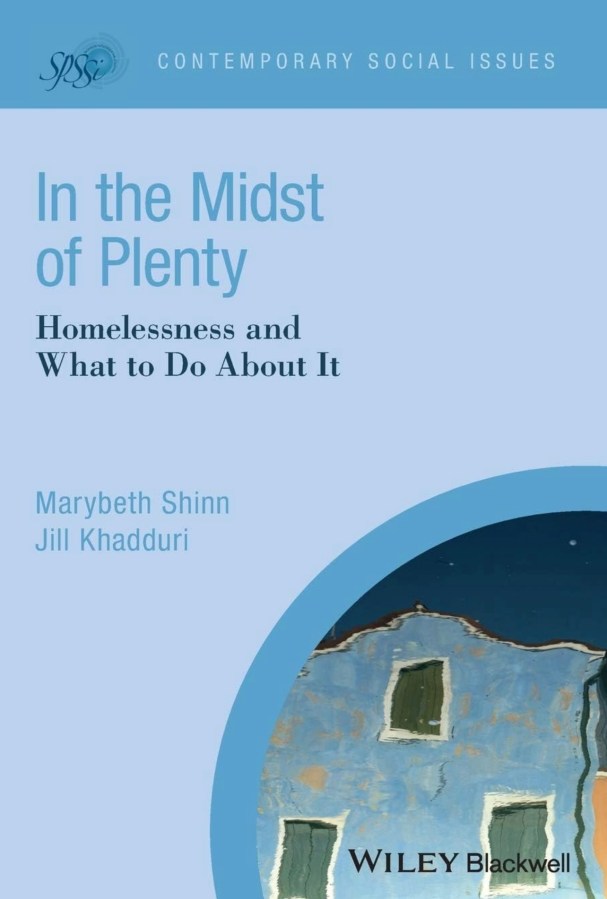

Professor and author Marybeth Shinn in her office at Vanderbilt University. Feb. 29, 2024.
By Brad Durham
On Thursday afternoon, February 29, I visited with Beth Shinn in her office at Vanderbilt University. Near the end of our conversation, she said something that stood out, “Homelessness is the worst manifestation of income and racial inequality in our country.” Shinn’s statement clearly illustrates the challenges facing the homeless population.
The following are excerpts from my interview with the professor and author of IN THE MIDST OF PLENTY – HOMELESSNESS AND WHAT TO DO ABOUT IT. I highly recommend purchasing the book and reading it. There is a wealth of research and positive solutions for ending homelessness in Shinn’s book.
Brad Durham: Please describe your background and position at Vanderbilt University.
Beth Shinn: I am a professor at Vanderbilt, and I have been studying how to prevent and end homelessness for over 30 years.
Brad Durham: Would you say that you have a passion for researching that and looking at solutions for homelessness?
Beth Shinn: That is my central focus.
Brad Durham: What made homelessness your central focus?
Beth Shinn: When homelessness started going out of skid rows and onto the streets, I was a young mother in New York. My kids would say, “Why is that person living there, why is somebody sleeping there? It is pretty hard these days to recapture the shock that we had at first seeing this in the mid-1980s.
Brad Durham: When did you start at Vanderbilt?
Beth Shinn: 16 years ago.
Brad Durham: In your 30 years of research, what have you found to be the best approach to solving homelessness?
Beth Shinn: We have a lot of evidence, and it is different for different folks. For families, a large-scale experiment that I was involved with, The Family Option Study, randomized nearly 2,300 families to housing intervention services. What we learned was that giving families access to housing vouchers that held their housing cost to 30% of their income not only ended homelessness, but also has radiating benefits for other aspects of family life.
Access to the vouchers reduced psychological distress and substance abuse, it reduced domestic violence, food insecurity… Some of the things that can cause homelessness were reduced simply by making housing affordable. Kids school attendance improved; their behaviors improved. We are in the field now with a 13-year follow-up to that study to see how long the affects lasted. How did being a kid in one of those families that had access to housing vouchers change the trajectories into adulthood? In another year or so, we will know the answer to that.
For folks with serious mental illness and substance-abuse problems, the approach that is evidenced-based and seems to work best is the original Housing First approach to supportive housing. People get housing with private landlords directly from the street without any prerequisites, and services under their control. The wraparound services are the ones that the people choose. Wraparound services include mental health services, substance-abuse services, but also vocational services for people who ask for job help, educational services, recreational services to help people build community. That approach has been shown in experimental studies to work much better than approaches that require people to be clean and sober before coming indoors.
There are some advantages to scattered-site housing with private landlords as opposed to putting people with problems all in the same buildings. Being in the same building is more convenient for the service providers, but not necessarily for the environment that people are trying to manage.
We also know something about the prevention of homelessness. The biggest issue there is identifying the people who are at-risk. The most common program is eviction-prevention. But most people who are evicted, do not become homeless.
One study in Chicago looked at people who called up the eviction hotline and qualified for the program. They compared people who called at times when there was money and when there was not money. What they found out was that when people called up when there was money, about half a percent became homeless in the next six months. When people called up and there was no money available, less than 2% of the people became homeless over the next six months. So the eviction help reduced homelessness, but 98% of the people who called up even when there was no help did not become homeless.
Eviction prevention helps, but that is not where most people who are experiencing homelessness are coming from. People who have a place from which they can be evicted are better off in terms of housing than folks who don’t.
Resources are the problem. We have shown that with resources, we can end homelessness. The country has cut homelessness for military veterans in half since 2010. That happened because we put in the resources. There was supportive housing for veteran families and other programs. There was preventive screening for veterans who came into veteran health services. They were asked questions about current homelessness, worries about insecurities about the future…
I don’t believe anyone should be homeless. We can fix it if we wanted to, but fixing it involves both getting people who are currently homeless out of that state and stopping generating more. At this point we are pitching people into homelessness faster than we are getting them out. Homelessness is rising.
Brad Durham: How do you change the public will so that the public cannot stomach having homeless individuals living on the street and in tents? There is a tent city area right outside downtown Nashville, not too far from us right now.
Beth Shinn: That is a good question. In this part of the country, one could appeal to moral values and religious tenets, “love thy neighbor.” If I could answer your question, I would be shouting it from the rooftops.
There is a lack of affordable housing. Nationwide, we have the highest level of “worst case of housing needs” since we started tracking these things. Worst case housing needs are people who are below 50% of the median income and are paying more than 50% of their income toward housing or living in seriously deficient housing. At this point nationally, we have 8.5 million renters who fall into that category as of 2021, which is the most recent report. That is the highest number we have ever had.
Those are people who are really strapped…people who are living below 50% of area median income and are paying more than 50% of their income for rent, which does not leave much room for paying anything else.
Brad Durham: How would you define homelessness?
Beth Shinn: There are two basic definitions of homelessness. There is what the Housing and Urban Development (HUD) uses, which sometimes is called literal homelessness. Someone who is sleeping outdoors or a place where people are not intended to sleep such as a bus station or in a shelter or other homeless serving programs.
There is a broader definition that the Department of Education uses that includes additional folks: the largest group is people who are doubled up in other households because they cannot afford a place of their own. There are some additional groups such as folks staying temporarily in hotels.
Those are the two big definitions. We try to count the people who are homeless according to the HUD definition in January. That number is going up. We try to count the number of people in schools who fit the Department of Education definition. That doesn’t count anyone who is below school age. In Nashville, that number is looking worse as well.
About a third of the people who experience homelessness are a part of families. The age that you are most likely to be in a homeless shelter in the United States is infancy.
Brad Durham: The Finnish model in your book is encouraging and inspiring. They eliminated homelessness.
Beth Shinn: We are wealthier than Finland. We could choose to do it. It’s a choice.
Brad Durham: Do we have the federal and state money to do it in Tennessee?
Beth Shinn: There is money through HUD, and the housing choice voucher program is something that needs to be expanded. The other thing the Feds do is the Low Income Housing Tax Credit, and that helps developers create more affordable housing. Even with that tax credit, developers cannot develop and maintain housing that poor people can afford. LIHTC helps developers provide housing to people who are at about 80% of median income. Getting that down to 30% of area median income is really tough, and that is where the need is.
If you look at the people who are experiencing homelessness, they are around 15% of area median income. Disability benefits are too low to afford a studio apartment anywhere.
State and local funds can help, but regulations are part of what is causing homelessness. In Nashville, we have down-zoned the number of units that are permitted. In 1950, you could have built a duplex or triplex in a place where now only single-family homes are permitted. We need to allow for greater density. We need housing on transportation corridors. Some people like to say that it is the housing and transportation cost that we should be looking at together. It doesn’t really help if you can get housing way out (from work) because it increases the transportation cost of commuting to work.
Zoning requirements for parking are another thing that makes housing more expensive to build. Nashville is removing zoning requirements for parking downtown. There is a tradeoff between having more parking spaces or more housing units.
The Tennessee state legislature has tied our hands to incentivize developers to build affordable housing. You can’t say in Tennessee that we will give you a zoning variance to build more units if 10% of them are more affordable. The legislature has nixed that from happening.
State and local funding can help, but state and local regulations hurts. We need changes to state and local regulations to make it more possible to build affordable housing.
Brad Durham: Are you optimistic in what you are seeing in your research, or are you pessimistic about the numbers you are seeing in respect to solving homelessness?
Beth Shinn: What leaves me optimistic is that we generally know what to do. It is really at this point a question of resources. We have shown that we know how to end homelessness with families. We have shown how to end homelessness for people with serious mental illness and substance abuse disorders. We have shown how to end homelessness for veterans. It is matter of resources and political will.
It is not a matter of the poor are always going to be with us and we don’t know what to do, so we should just bury our heads in the sand. We have a lot of knowledge. We know something about prevention. We could know more there. We know something about what is generating homelessness. There is a GAO report that indicates that for every $100 increase in rent in a city (technically a continuum of care) there is a 9% increase in homelessness.
We need to build things that are not all mansions. We need to build smaller homes, what used to be called starter homes. Not everyone needs three bedrooms and 2.5 bathrooms and a white picket fence. We need to offer more kinds of housing to people.

 BD Newsletter
You must be logged in to post a comment.